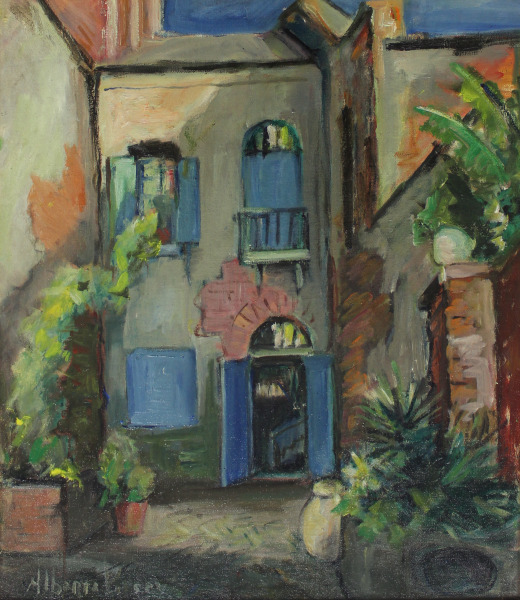
French Quarter Courtyard with Blue Shutters
Alberta Kinsey
1875-1952
A Midwesterner by birth, Alberta Kinsey fell in love with New Orleans and became a force for the preservation of the old city. Her picturesque scenes of the French Quarter engaged both locals and tourists.
A Quaker, Kinsey was born on a small farm near West Milton, Ohio, a few miles northwest of Dayton and went to a rural one-room school. She attended the Cincinnati Art Academy where Thomas Noble served as the head and also the Art Institute of Chicago. She was an active member of Cincinnati Women's Art Club and became an art instructor at Lebanon University, a teacher's college (formerly National Normal University) located about thirty-five miles from Cincinnati. The school went bankrupt and closed in 1917, and the following year Kinsey moved to New Orleans because, as she later explained, "the name pleased me … it was warm here."
Initially Kinsey rented space in an apartment building on Toulouse Street in the heart of the French Quarter, which at the time was a derelict and therefore questionable place for a young, unaccompanied woman. She soon became acquainted with some local artists including Caroline Durieux, Angela Gregory, and Ellsworth Woodward—with whom some sources say she studied, possibly at Sophie Newcomb College where he taught. Her studio was the location of the first formal art class in the French Quarter and in 1919 she instigated the Artists Guild. Two years later the organization regrouped to become the Arts and Crafts Club of New Orleans, "to foster higher artistic standards and… assist generally in the promotion of the arts and crafts." The Club sponsored exhibitions and lectures (including Gertrude Stein's in 1935), and its classes nurtured the likes of Will Henry Stevens and John McCrady. The Club was instrumental in the preservation of the city and was hailed in the local press as responsible for "the Renaissance of the Vieux Carré."
Kinsey's passion for her adopted home is evident in her many intimate views of courtyards and facades. "When I came to New Orleans, I wanted to paint," she said. "I didn't have a great talent or the genius for it, but I did have the desire. It was love at first sight, even before I had seen a patio or mounted a creaky stair in the old houses I love so much." In the 1920s she traveled to Europe where she discovered a variety of Modernist approaches which prompted a change in her work from romantic Realism to more stylized viewpoints. "I've painted about every patio in the Quarter, but once a year I just must try contemporary painting. I just love the patios, like you feel for an old sweetheart—but nonobjective art is like a new beau. Those paintings don't mean anything. If I put a line here, it calls for another one there—and then another one over there. I hope the change of pace will help me do a better job on the patios."
In addition to her urban scenes, Kinsey painted floral still lifes, and once in a while, landscapes. Upon occasion she visited historic Melrose Plantation, located in north central Louisiana, and on one visit around 1940, according to legend, she intentionally left behind brushes and some tubes of paint which inspired Clementine Hunter to become a painter. Kinsey taught at the Isaac Delgado Museum of Art (now the New Orleans Museum of Art) and displayed her paintings outdoors in Orleans Alley (now known as Pirates' Alley), near the historic property on Royal Street that she restored. Although she was immersed in the art and preservation of New Orleans, she also made trips to Taos, New Mexico. Kinsey's life was devoted to the art community from the West and Midwest to the South. Today, her paintings demonstrate a deep admiration for Southern scenery, and breathe life into the historic alcoves and courtyards of New Orleans.
Alberta Kinsey