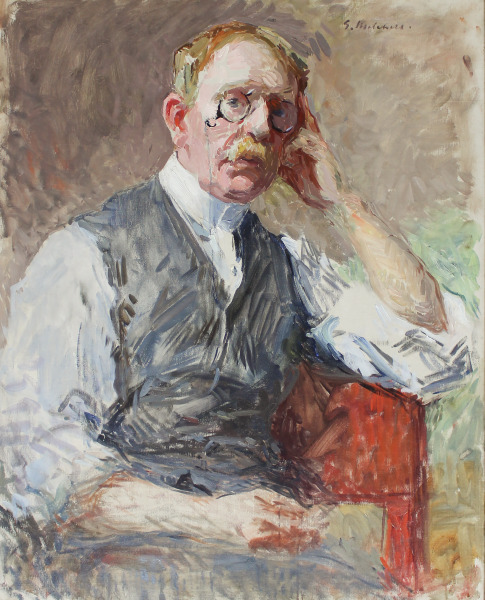
Portrait of a Man
Gari Melchers
1860-1932
Precocious and prolific, Julius Garibaldi Melchers (Gari) completed numerous easel paintings and several significant murals. His work featured elements of Realism, Symbolism, and Impressionism in that order. He was described in 1908 by a critic with these words: "He lives to paint: he would rather paint than do anything else; life to him would be barren and tedious without his craft. Most other painters have ulterior interests and relaxations—his relaxation is to turn from painting the figure to painting landscape."
Melchers was born in Detroit, Michigan, the son of Julius Melchers, a German-trained sculptor who left what used to be the Kingdom of Prussia in Germany after the revolutionary turmoil in 1848. He gave his son the middle name of Garibaldi, after the great Italian patriot credited with the unification of Italy. At age eighteen, urged by his father, Melchers began his studies at the Royal Academy in Düsseldorf, known for its attention to drawing and emphasis on realistic details and bright colors. He was a student there from 1877 to 1880 before shifting gears and going to Paris where he enrolled at the Académie Julian from 1880 to 1886, as well as the École des Beaux Arts. Melchers was met with some success; his paintings were selected for exhibition at the prestigious Paris Salon in 1882, 1883, and 1886.
Continuing his expatriate status, in 1884 Melchers moved to Egmond aan Zee, a small fishing village in northern Holland, where he played a role in establishing an art colony. He mostly painted the local peasants and carefully detailed their costumes which often consisted of elaborate embroidered fabrics. He retained a residence in Egmond until 1922, making regular trips to New York, Paris, and Brussels in addition to the locations where he painted murals. Beginning in 1906, he taught at the Ducal Academy of Fine Arts in Weimar (an early precursor to the Bauhaus-Universität Weimar), Germany, but with the advent of war, he left in 1914 for New York.
Melchers's academic training proved useful when he was commissioned to create murals for the 1893 World's Columbian Exposition in Chicago, Illinois; the murals are now located in the library at the University of Michigan in Ann Arbor. In 1895, he completed two lunettes for the Thomas Jefferson Library of Congress Building in Washington where he depicted War and Peace using semi-nude classical figures arranged in friezes. In Chicago and Washington, he may have encountered William de Leftwich Dodge who was working on murals in each place at the same time. In 1921, Melchers undertook three murals for the Detroit Public Library depicting the history of the city, and the following year he completed a similar series for the Missouri State Capitol in Jefferson. One of the four large panels (twelve by five feet) was a likeness of Mark Twain. He was compensated with the sum of $20,000, equivalent to $380,000 in 2025.
Around 1900, Melchers began to paint impressionistically using a loaded brush and broken brushwork. As a result of connections that his wife, Corinne Mackall, had with Savannah, Georgia, (her birthplace) Melchers became an advisor to the Telfair Academy of Arts and Sciences (now Telfair Museums), the oldest public art museum in the South. He followed Carl Brandt, the first director, and served as a part-time fine arts advisor charged with expanding the collection as well as offering advice on installations and museum administration. From 1906 to 1916, Melchers typically visited Savannah twice a year, and continued in an advisory capacity into the 1920s. He was well-positioned for these tasks given his reputation and ties to the art world. The acquisitions made during his tenure reflect his taste and emphasize American and European Impressionism.
In 1916, Melchers purchased Belmont, a Georgian-style frame house dating to the 1790s in Falmouth, Virginia, across the Rappahannock River from Fredericksburg. The twenty-five acres and the house were in disrepair, but both the artist and his wife took great pains to restore them. Upon Corinne's death, Belmont was given to the Commonwealth of Virginia to be used as the Gari Melchers Memorial and Art Center (now known as Gari Melchers Home and Studio). Over the door to the studio was a sign that read: "Whar un Klar," meaning "Truth and Clarity." The collection there consists of 1600 drawings, sketches, and paintings as well as an extensive archive.
Gari Melchers