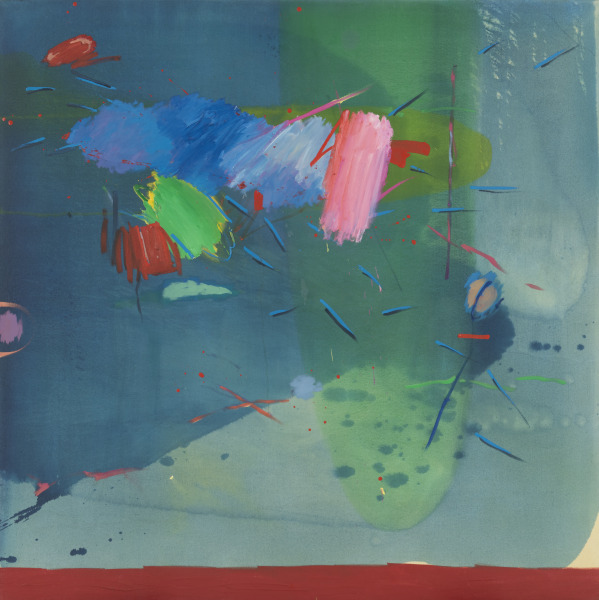
Priory Mew
Ted Potter
1933-2006
Ted Potter was known for his lyrical abstractions as well as satirical figurative images, but he was also a highly regarded arts administrator. He was involved with the National Endowment for the Arts as a fellow, panelist, and one of its great defenders in the funding controversy instigated by Senator Jesse Helms in the late 1980s over the exhibition of so-called obscene art.
Potter was born in Springhill, Kansas, and grew up in a suburb of Chicago, Illinois. In high school he was on both the basketball and tennis teams while continuing his passion for drawing. He attended Baker University in Baldwin, Kansas, where he lettered in basketball and was a Mid-American tennis champion. Although he majored in philosophy and psychology, he took as many art courses as possible. He graduated in 1954 with a Bachelor of Arts degree. He was then drafted into the United States Army and was stationed in Oakland, California, where he studied art at night at California College of Arts and Crafts (now the California College of Arts and located in San Francisco).
Upon his discharge in 1957 Potter returned to the Midwest and spent a year at the University of Kansas. Then California beckoned him back, in part because of the Bay Area Figurative artists whom he greatly admired; for three months he studied at the University of California at Berkeley. He soon became disenchanted with the emphasis on Abstract Expressionism. As a result, Potter returned to the California College of Arts and Crafts where he completed his master’s degree in 1961. Afterward he worked for a while as a buyer for a clothing firm until he found a position at an art gallery in Sausalito. Between 1965 and 1967 he was the arts director for the San Francisco-based Glide Memorial Foundation, and in 1966 he curated an exhibition focusing on the Haight-Ashbury district, which was gaining a reputation for its hippie counterculture. Potter lived in the neighborhood which the 1967 “Summer of Love” made famous, thus he was in a good position to organize an exhibition of its artists.
Although he had been offered a position as an assistant curator at the Oakland Museum, in late 1967 Potter moved to North Carolina to become the first professional director of the ten-year-old Winston-Salem Gallery of Fine Arts. Almost immediately he changed the name to the Gallery of Contemporary Art, and altered it again in 1974 to Southeastern Center for Contemporary Art (SECCA). Since 2007 the organization has been known as The North Carolina Museum of Art, Winston-Salem. Potter remained there for twenty-four years, until 1991, and became a force for contemporary art in the Southeast. He instigated an annual series of exhibitions called The Southeast 7 which spotlighted upcoming artists and circulated to regional museums. While at SECCA in 1989 he daringly exhibited Andres Serrano’s controversial Piss Christ and as a result was investigated by a congressional committee amidst charges of blasphemy.
After leaving SECCA he served as director of the Atlantic Center for the Arts in New Smyrna Beach, Florida, 1991–1993, followed by a stint at the Contemporary Arts Center in New Orleans from 1993–1996. His last position was as associate professor of art and director of the Anderson Gallery at the School of Arts, Virginia Commonwealth University in Richmond, Virginia. Throughout, Potter tended to resist the dominance of New York’s art world, instead celebrating more regional talent. He also served in an advisory capacity to many national corporations, arts organizations, and several boards, including the Black Mountain College Trust and the National Endowment for the Arts.
While in school, Potter had experimented with abstraction but afterward wanted to engage viewers more easily, so he developed an extensive body of work in which he portrayed people facing frontally. The handling and color tended to be expressive. In his mid-forties, he returned to non-representational work and painted by pouring and dripping on large scale canvases which he had placed on the floor. Then once again changed direction, reverting to figural imagery that sometimes verged on caricature. Tom Patterson in his 2006 essay described a late body of Potter’s work: “The Inside the Ropes paintings reflect Potter's belief that people in the arts—artists, art administrators, board members, curators, critics, art students and patrons—tend to take themselves far too seriously and could stand to laugh at themselves more often. They’re amusing parodies of standard art-world scenarios, but they’re also serious paintings in more than one respect. They raise important issues regarding the dynamics of power as played out in the art world, and they’re aesthetically noteworthy for their successful fusion of abstract and figure technique.”
Ted Potter