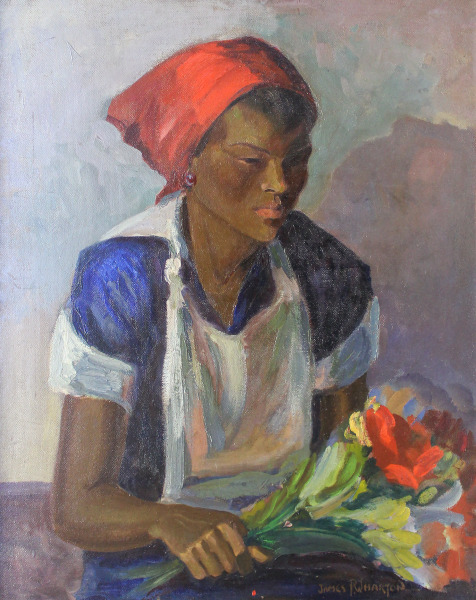
Untitled
James Wharton
1893-1963
A native of the South, James Pearce Wharton had a diverse career as a distinguished army officer, a dedicated artist, and college teacher. Wharton was born in Waterloo, South Carolina, in upstate Laurens County. He attended Lander College in nearby Greenwood, followed by studies at Wofford College in Spartanburg in 1914. The following year he obtained his Bachelor of Arts degree from Duke University in Durham, North Carolina. A position as the Physical Director at the Young Men's Christian Association lasted one year, 1915–1916, before he enlisted as a private in the United States Army in 1917. He served in the Tank Corps in France during World War I. He married his first wife in North Carolina in 1918; the following year she gave birth to his only son. Wharton studied for a short stint at the École des Beaux Arts, Dijon, France, in 1919, while also continuing his military training with the graduate tank school at Fort Meade in Maryland. In 1923 he studied at the Maryland Institute in Baltimore and personally with Wayman Adams and Leon Kroll. By this time, he and his first wife had divorced, and he met fellow artist Carol Forbes, who he married in 1929.
Wharton's military career took him all over the country, and at times, his military assignments overlapped with art activities and even art education. He was the public relations officer for the third corps area in Baltimore, from 1926 to 1931. He then moved to the infantry school at Fort Benning, Georgia, 1931–1938, where he was head of the Columbus School of Art, 1933–1938. Also during this time, one of his paintings was included in a 1936 exhibition at the High Museum of Art where works by some established Savannah artists including Lila Cabaniss and her sister Mary Hope Cabaniss, Hattie Saussy, Emma Wilkins, and Christopher Murphy, were also on view. Wharton even contributed illustrative features to the Sunday magazine section of the Atlanta Journal for a series called "It Happened in Georgia." Following his time in Georgia, he was deployed to Manila in the Philippine Islands with the 31st infantry, 1938–1941, and for those years also served as Head of School for the Manila School of Art.
Returning to his home state, Wharton was assigned to the 8th infantry at Fort Jackson, South Carolina from 1941–1942, and then ended his time in the military with the third service command in Baltimore, Maryland, 1941–1946. After twenty-nine years, he obtained the rank of colonel. He also became a decorated order of the British Empire soldier and additionally received a commendation from the United States Army. Even within the military, he was known for his involvement in the arts, as he was commissioned to paint portraits of several generals and a governor of Maryland and created covers for the Army's publication, Infantry Journal. Two years after his military retirement, he devoted himself to the arts, starting with a position as head of the art department at the University of Maryland in College Park. He was also the founder and director of the Flat Rock School of Art in Hendersonville, North Carolina. Wanting to continue his own education, he also pursued a Master of Fine Arts degree at the University of Guanajuato, Mexico, where he graduated in 1952. After the death of his wife, Carol Forbes, in 1958, he met and married Helen Duffy in 1961. Twenty days after their marriage, they were involved in a car accident that resulted in Helen's death.There was speculation about the intentionality of her death and, two years later, while a patient at a military hospital, Wharton took his own life. A satisfactory conclusion in the case of Helen's death was never reached.
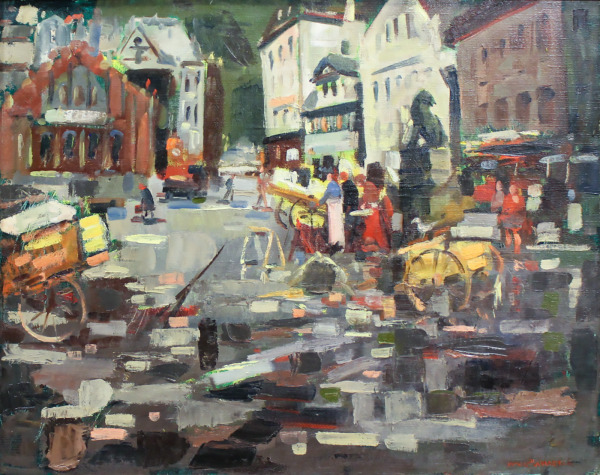
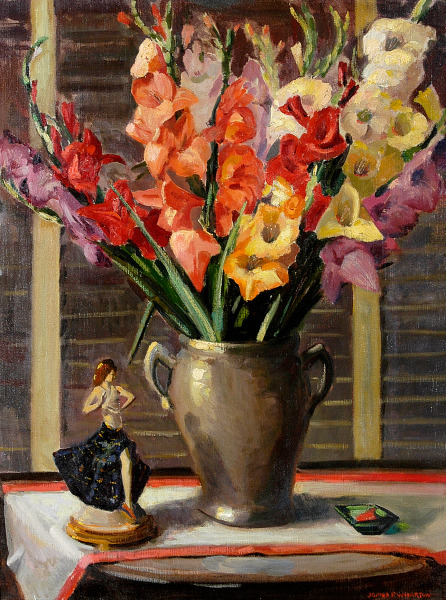
Wharton's style appears to have been moody and representational, with splashes of vivid color, but he never settled on a particular composition or medium, illustrating and painting everything from formal portraits to still lifes to buildings on the University of Maryland campus. His everyday inclinations place his style amongst other Regionalists of the era, but many of his pieces also read as impressionistic. Though his military career did not prevent his involvement in the arts, his career as an artist seems to have been secondary for most of his life. This may be one of the reasons his personal life stayed out of the spotlight; only speculation about his and his wife's death have given any indication of inner turbulence.
James Wharton
James Wharton
James Wharton