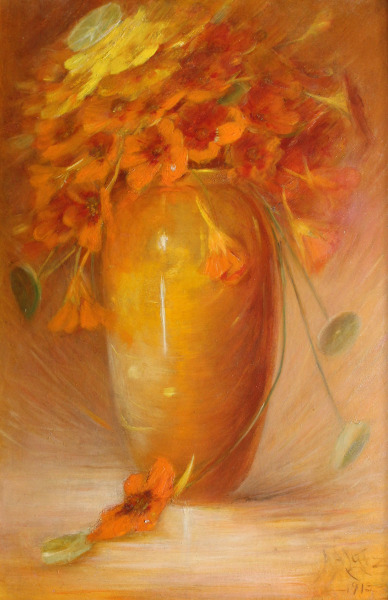
Still Life (Flowers in a Vase)
Adelia Lutz
1859-1931
According to an 1893 publication about leading American women, Adelia Ann Armstrong Lutz "from her childhood breathed an atmosphere of refinement and culture." This continued into her later years when she and her husband commissioned an imposing home and studio called Westwood, where they hosted friends and fellow artists; it was placed on the National Register of Historic Places in 1984.
Lutz and her twin sister were born at the home of her maternal grandparents in Jefferson County, Tennessee. Her paternal grandfather, Drury Armstrong, owned extensive land in Knoxville, Tennessee, and fifty thousand acres that became part of the Great Smoky Mountains National Park. At the age of four the artist was living in Bleak House, an antebellum classical revival house in Knoxville that had been used by Confederate generals as headquarters. The daughter of an amateur artist, Lutz was a creative child, doodling in her schoolbooks, painting flowers on their covers, and drawing illustrations for her favorite novels. When she was fourteen she won a first-place prize for a drawing at a local fair.
Initially Lutz attended Knoxville's East Tennessee Female Institute in the early 1870s and then proceeded to Baltimore, Maryland, for further education at an institution variously called the Southern Home School or Miss Pegram's School. From there Lutz went to the Augusta Female Seminary in Staunton Virginia, (now Mary Baldwin University). When she was twenty-six she took art courses at the Corcoran School of Art in Washington, DC, followed by a stint at the Pennsylvania Academy of the Fine Arts in Philadelphia. At some point she made a tour of Europe.
Lutz returned to Knoxville in 1886 and established herself as a teacher in a downtown location. Alongside a friend she taught drawing, painting, and embroidery; her students were mostly women from prestigious families. In an 1893 talk she stated: "Art is something accomplished. It is the birth of a new joy into the world. Art teaches you the philosophy of life—it shows you that there is no perfection. There is light and there is also shadow. Everything is in half-tints." After her marriage to John Lutz in 1886, she helped to plan their impressive home, known as Westwood. A fourteen-room brick house built in the Queen Anne style with exterior details described as Richardsonian Romanesque, its most remarkable feature was Lutz's studio. A single large room, it boasted red walls, a cathedral ceiling with skylights, and a fireplace with tiles displaying portraits of her favorite authors.
Along with welcoming visitors and fellow artists to her studio, she became active in the Knoxville Art Club (later the Nicholson Art League) which counted among its members Lloyd Branson and Catherine Wiley. Lutz served as the president of the league 1903/1904 and assisted in the art exhibits held at the Appalachian Expositions of 1910 and 1911. In addition, in 1913 she served on the Executive Board of the Art Department for the National Conservation Exposition which focused on the natural resources of the South. Examples of her work as well as some by Branson and Wiley were on view. Lutz occasionally painted portraits of children, in particular her own. But she was better known for her depictions of flowers, hollyhocks in particular, which were planted in abundance in her garden at Westwood.
Adelia Lutz