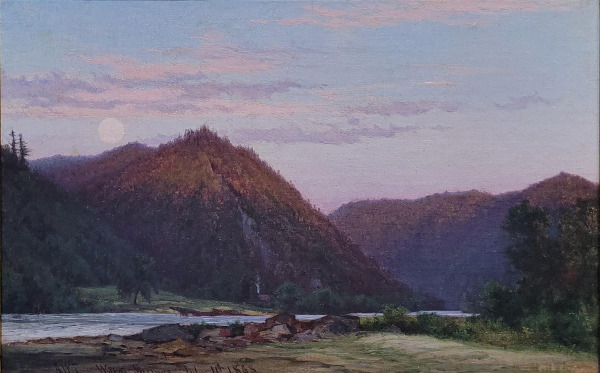
Warm Springs, Virginia
Alfred Thompson
1840-1896
Alfred Wordsworth Thompson traveled to Europe, North Africa, and the southern United States in pursuit of inspiration for his paintings. His work reflected a deep visual interest in American colonial history and a fascination with foreign cultures. He tended to sign his paintings using just an initial for his first name, so that his signature appeared as "A. Wordsworth Thompson."
Thompson was born in Baltimore, Maryland, where he enrolled at the short-lived Newton University in preparation for a career in his father's law practice. He abandoned that avenue, instead turning to art. Just prior to the Civil War he opened a studio, and then produced—like Winslow Homer and Henry Mosler—illustrations for Harper's Weekly as well as the Illustrated London News. As an artist-correspondent, Thompson worked largely in Virginia. Of particular significance is a likeness he did for Harper's of the abolitionist John Brown during the latter's incarceration.
After less than a year, Thompson took off to Europe where he remained until 1868. In Paris he studied at the École des Beaux Arts under the academic history painter Charles Gleyre, the landscapist Émile Lambinet, and Alberto Pasini, an Italian who specialized in exotic scenes of the eastern Mediterranean. A landscape painting by Thompson was selected for exhibit at the 1865 Paris Salon. At the end of his sojourn he traveled to Germany and Austria and did a walking tour from Heidelberg in Germany to Calabria in southern Italy, a distance of about one thousand miles.
Upon returning to the States he established a studio in New York City where he became active with the National Academy of Design; he was elected an Academician in 1875. His obituary commented that "he was one of the academy's most faithful exhibiters, as well as one of its most successful." The paintings he showed—over one hundred—were landscapes and narrative scenes of the American Revolutionary War era. As a member of the hanging committee one year, he was involved in a controversy when several canvases by young European-trained artists were given places of honor. When the authorities complained, the committee held its ground.
During the 1880s, Thompson began traveling again, visiting Europe, Turkey, and Morocco. The resultant images feature colorful scenes replete with people dressed in flowing garments, horses, and distinctive buildings. Thompson retreated to Summit, New Jersey, where he spent the last twelve years of his life in semi-retirement.
Alfred Thompson