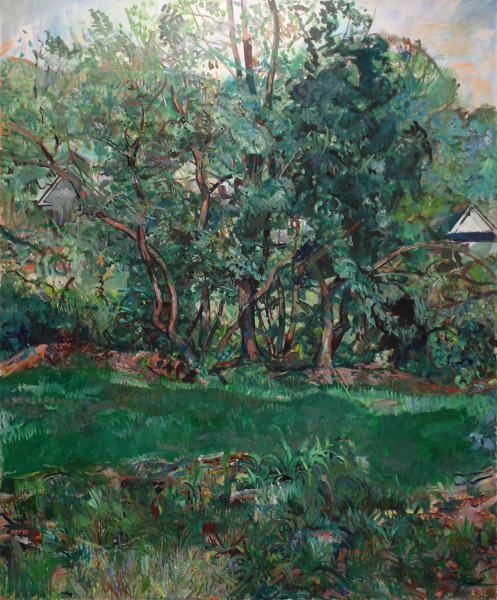
Landscape: Back Yard
Andrew Martin
1923-1997
Even though his father was a noted sculptor in France, Andrew (André) George Martin preferred painting, which he did on a large scale and with a painterly application of pigment.
Initially known as André, Martin was born in Rambouillet in the Île-de-France region, thirty-five miles southwest of Paris and a destination replete with historic sites related to King Louis XVI. His father, Joseph Camille Martin, was a figural sculptor who was studying at the École des Beaux Arts when World War I broke out. After serving with distinction in the military, he worked on several war memorials in France. In 1929 the family immigrated to the States and arrived in Chicago, where Joseph Martin had hoped to work for the Northwestern Terra Cotta. There were, however, no positions when he got there, so he worked instead for Marshall Field and Company department store.
Young Martin, who changed his name to Andrew, was naturalized as an American citizen in 1937. He spent his early years in Chicago and between 1939 and 1941 studied at the School of the Art Institute. For a time he was employed by the Continental Illinois National Bank before moving to Seattle, Washington, around 1943. He was doing technical illustration work there before he joined the military and was stationed close by at Fort Lewis and was assigned to the Army Air Corps. Following the war he returned to the country of his birth and studied at the École des Beaux Arts from 1947 to 1950. By 1957 Martin was in New York City, the so-called center of the art world. In 1965 he took a position in the art department at the University of North Carolina, Greensboro (UNCG) where he remained until 1995.
Teaching at UNCG for thirty years earned a reputation for his academic approach. Inspired by him, his students called themselves “The Greensboro School.” Martin, who only had a high school degree, had reservations about university life: “There is a lot of intellectual ferment in academia. A lot of garbage. You have students who go to school and become learned and discuss theory and technique and come out and don’t know how to do anything.” His own paintings were done in a large format with bright colors and open brushwork. On a number of occasions, he depicted a scene of bathers gathered outdoors in a cubistic style reminiscent of Paul Cézanne. He was reluctant to discuss his work, saying: “I don’t really like to talk about it. Whatever you’re doing should speak for itself. I don’t want to be the guy who paints and then discusses his paintings. I think most artists don’t like to do it.” He further explained that paint is “a kind of a dialogue. Relationships get established with the paint.”
Andrew Martin