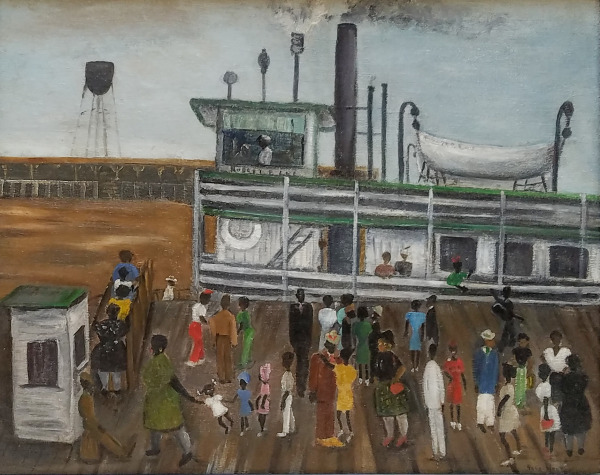
Ferry Across the Savannah River: Embarking on the ‘Robert E. Lee’
Anna Hunter
1892-1985
When her husband's premature death in 1936 left her with three young children to support, Anna Habersham Colquitt Hunter needed a job. Following the example of her older sister, a successful journalist in South Carolina, she secured a position with a Savannah, Georgia, newspaper. Over the years, her purview at the paper expanded, she learned to paint, and became a key figure in historic preservation efforts in the city.
Born in 1892 in Anniston, Alabama, Hunter grew up in a family home situated along the river in Savannah. She attended the Pape School, a progressive institution for girls, which in 1912 sponsored the first two Girl Guide/Scout troops in this country. She matriculated at Agnes Scott College in Decatur, Georgia, but cut her studies short to marry George L.C. Hunter in 1913. Once widowed she went to work as the society columnist at the Savannah Evening News and then the Savannah Morning News. Like most other female journalists of the day, she was initially assigned to the society pages, but ultimately she advanced to become the outlets' book page editor and an editorial writer.
Despite being over fifty years old, Hunter served as field director in the American Red Cross during World War II. In both North Africa and Italy, she oversaw rest and recovery stations for combat soldiers. When she left Italy she was recommended for a Bronze Star medal. Back in Savannah at war's end, Hunter's journalistic responsibilities shifted. Along with general reporting, she became the newspaper's literary, dramatic, and visual arts critic. Having little formal experience in these areas, she set out to learn more about her subject matter by taking classes in theater, as well as a children's art course, at the Telfair Academy of Arts and Sciences (now Telfair Museums).
Hunter's education in the fine arts, however, came through her own practice, as she taught herself to paint local streetscapes and waterfronts, agricultural scenes, and gatherings of people at churches and dances. These were rendered in a simple direct manner; one critic described her as "the Grandma Moses of the South." At some point in her career, she did receive some instruction from Augusta Oelschig and Reuben Gambrell. A brochure printed in connection with a 1948 solo exhibition opined that the viewer "feels she loves to paint her subject and that she paints the subject she loves." Decades later, in 1973, the Telfair organized an exhibition of her paintings.
Alarmed by the demolition of Savannah's old city market, Hunter assembled a group of ladies, known as "The Seven Women," to press their fellow residents to preserve the city's heritage. As a co-founder of the Historic Savannah Foundation, established in 1955, she helped to rescue and restore the Isaiah Davenport House, a Federal style home built in 1820. The foundation acknowledged her as "the founding spark of Historic Savannah Foundation. It was her energy, brilliance, determination, and tireless work that awakened the citizenry to the value of restoring the deteriorating buildings in the old part of Savannah." Over time, the foundation's efforts have led to the preservation of four hundred structures. Hunter was the first woman to receive the Oglethorpe Trophy, the city's top civic award, and the Thomas Gignilliat Award in recognition of her contributions to community culture. Her accomplishments have been celebrated in an opera, Anna Hunter, The Spirit of Savannah, as well as a book, Restoring Lost Times: Savannah's Anna Colquitt Hunter.
Anna Hunter