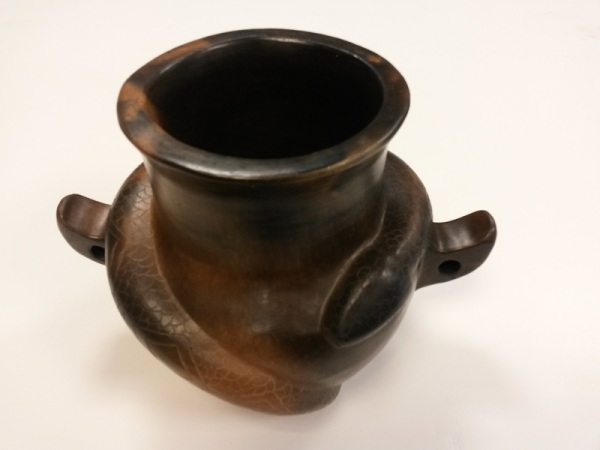
Snake Pot
Bill Harris
Born 1953
Floyd William (Bill) Harris’s pieces are more art than functional ware, serving as emblems of cultural identity. They exemplify the long tradition of Catawba pottery crafted from mud dug from the banks of the Catawba River. As a community leader, Harris was keenly aware of the historical significance of pottering, a practice that stretched back through generations of Harris’s ancestors for at least 4,000 years. He once stated: “What we do with clay is, in many ways, in our DNA. We have never given up on clay; we have kept the tradition alive all these years.
Harris attended Rock Hill High School in north central South Carolina and graduated in 1972. He learned his craft from his grandmother, Georgia Harris, who received a National Heritage Fellow designation from the National Endowment for the Arts in 1997. He explained once that when he was younger, “there weren’t many forms of entertainment, so I became fascinated watching what my grandmother’s hands could do with mud—which is what I called it back then. She was able to make these beautifully balanced vessels playing with mud. When I became older and wiser, I realized something within my soul was drawn to that mud and that I needed to make time to learn from her.”
Before he became an outstanding Catawba potter Harris was a furniture maker and woodworker, which he did until his mid-forties. For his pots, his method is traditional: mud from the river, ground into a fine powder; water added to make pliable coils to construct the pot, not using a potter’s wheel; sun drying the vessel before firing it in a pit, then burnishing the surface to give the typical glass-like sheen, never using paint or glazes. Sometimes Harris incised the surface with a sharp instrument, often to reinforce the image of an animal. He has admitted: “I’m definitely pushing the envelope of our work. I’m bringing those traditional vessel shapes forward but at the same time modernizing them with effigies. So it’s not the same as what our people were doing 1,000 years ago. But even then, they weren’t doing what was done 1,000 years before them. We have always been pushing and progressing.”
For his commitment to sharing his traditional art form within the community, Harris’s talents were recognized in 2016 with the Jean Laney Harris Folk Heritage Award, selected by the South Carolina Arts Commission together with McKissick Museum at the University of South Carolina. He also received a Taproot Fellowship given by the Alliance for California Traditional Arts. In addition he has been named a Master Potter by the Catawba Cultural Preservation Project in appreciation of his years of dedication to preserving and honoring traditional pottery craft. Elected Chief of the Catawba Nation in 2011, he held this position until 2023, and during his tenure he spoke frequently to school and community groups; and in 2023 he was artist-in-residence at the University of South Carolina Lancaster. Clearly an advocate for his people, he has described their qualities in the following way: “Indigenous communities have been tested over and over again, and we have persevered through so many hardships. And yet we still have laughter; we still have joy. You can take away a lot of things from people, but you can’t take away their spirit.”
Bill Harris