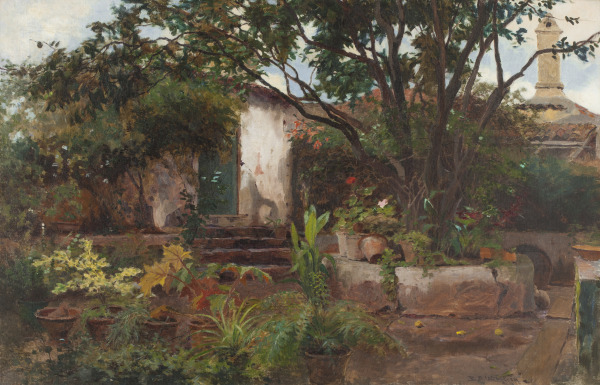
Garden at the Sun (Spanish Colonial Garden)
Bror Wikstrom
1854-1909
After spending nearly a decade as a sailor on open waters, the Swedish immigrant-artist Bror Anders Wikstrom discovered New Orleans in 1883. Captivated by the city’s charm and limitless subject matter, he made it his home for the rest of his life. He became an active presence in the local art scene and was one of the founders of the Artists’ Association of New Orleans, an influential circle that promoted regional art through exhibitions and education around the turn of the century. He taught sketching at the association’s school without pay, regularly participated in its exhibitions, served on juries, and became the organization’s president in 1892; he was also the driving force and benefactor of the association’s short-lived literary publication, Art and Letters.
Wikstrom was a versatile artist, having trained in the academic tradition at the Royal Swedish Academy of Fine Arts in Stockholm and in Paris. Over the course of his career, he worked as a magazine illustrator, executed portraits, painted historical and genre scenes, and recorded his impressions of the open sea and the picturesque Louisiana landscape. He exhibited locally and at the 1897 Tennessee Centennial Exposition in Nashville, as well as at the 1904 Louisiana Purchase Exposition in St. Louis, commonly known as the World’s Fair.
Wikstrom’s greatest success, however, came as a designer of Carnival floats and costumes. Spanning a quarter century, his resplendent productions for the Rex and Proteus krewes were colorful and imaginative, their themes derived from exotic Middle Eastern literature such as The Rubaiyat of Omar Khayyam and The Arabian Nights. These Mardi Gras commissions, which began in 1885 and continued until his death, brought Wikstrom substantial wealth. Financial freedom, in turn, allowed him to enjoy regular European travel—frequently returning to his native Sweden and to France—as well as trips to the Caribbean, Mexico, and in America.
In its review of the 2nd annual exhibition of the Art Association of New Orleans, the Daily Picayune called “Garden [at] the Sun” “one of [Wikstrom’s] most important works,” with a detailed description of “an odd Tenerife inn courtyard, vine clad and flower-grown, and so intensely picturesque that one would be tempted to take the next steamer for the Canaries.”
Bror Wikstrom