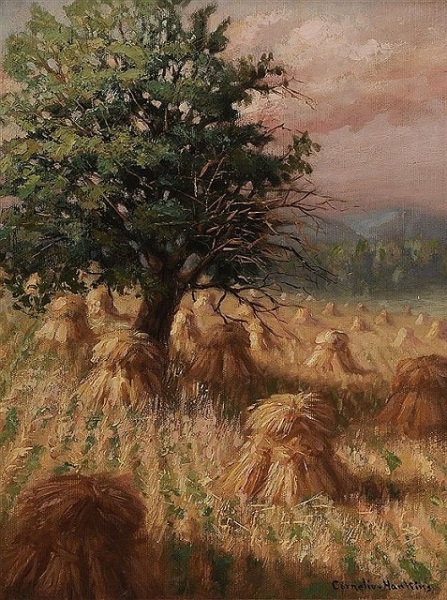
Wheatfields of Tennessee
Cornelius Hankins
1863-1946
Cornelius Haly Hankins was a prolific portraitist who specialized in likenesses of Confederate War veterans, many of which were done posthumously from photographs. He also painted landscapes throughout the South.
Hankins was born in the midst of the Civil War either in Guntown, Lee County, or Itawamba County, Mississippi, both of which are located in the northeast part of the state. His mother nursed for Confederate soldiers, and as a result he contracted smallpox as a child and lost his hearing. For this reason he was tutored at home. In 1883 he moved to Nashville, Tennessee, and took lessons from Edwin M. Gardner who had studied at the Royal Academy of Art in Belgium. Hankins proceeded to New York where he studied with Robert Henri and William Merritt Chase.
Between 1894 and 1899 he resided in Richmond, Virginia, where he taught at the Richmond Art Club. In addition, he painted posthumous portraits of twelve Confederate generals. In 1901 he was commissioned by the Tennessee General Assembly to paint a likeness of General Robert E. Lee and subsequently he did fifteen portraits for the Shelby County courthouse in Memphis, Tennessee. By the time of his death in 1946, significant numbers of Hankins’s portraits were hung in southern state governmental buildings including the Tennessee State Capitol (nine) the Alabama State Capitol (six), the Mississippi State Capitol (two), and the Louisiana State Capitol (one).
Around 1904 Hankins returned to Nashville and in addition to portraiture he painted area scenery. These tend to be realistic and earthy-toned, often of bucolic farms, rather than dramatic panoramas. He also traveled widely and depicted landscapes in Florida and near Asheville, North Carolina, as Hankins painted still lifes, some of simple objects in the manner of his instructor Chase, while others are more complicated floral compositions.
Cornelius Hankins