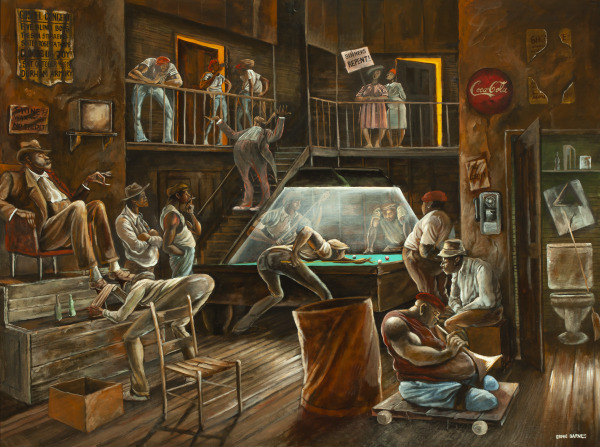
Saturday Night Durham, North Carolina
Ernie Barnes
1938-2009
Well known in both the professional sports and visual arts worlds, Ernest Eugene Barnes's experience as an athlete was pivotal to his development as a painter of rhythm and vigor. He has been celebrated as "the most expressive painter of sports since George Bellows." In his own words, Barnes's work offers "a pictorial background for an understanding into the aesthetics of Black America."
Born in Durham, North Carolina, during the Jim Crow years, Barnes did not have access to art museums. Instead, he familiarized himself with art history in the personal library of his mother's prominent employer. Bullied because of his weight as a youth, Barnes sought acceptance through athletics and relied on art as an emotional outlet. In 1956, Barnes enrolled at North Carolina College (now North Carolina Central University) on a full athletic scholarship and pursued a degree in art.
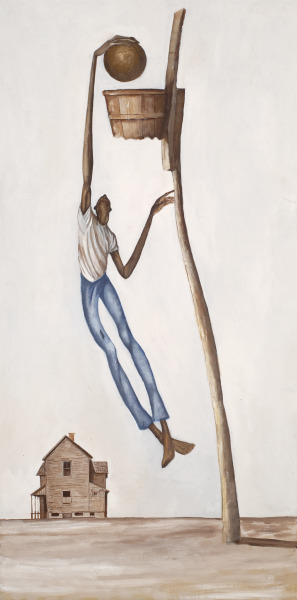
One influential college instructor urged Barnes to translate the physical movement of his body on the football field to the canvas—a lesson Barnes never forgot. His sports and tavern paintings, populated with expressive, elongated figures reminiscent of Parmigianino or Michelangelo's later work, have been described as Neo-Mannerist. These figures are most often depicted with their eyes closed, a practice Barnes adopted to illustrate "how blind we are to one another's humanity" and the tendency to "stop at color." He preferred to present his paintings in frames made of distressed wood inspired by the ramshackle fence that had encircled his childhood home in Durham.
Barnes played in the American Football League (AFL) as a lineman from 1960 to 1965 and briefly for the Canadian Football League. However, after suffering a career-ending foot injury in 1965, Barnes devoted himself to art, becoming the official artist of the New York Jets and, later, of the 1984 Olympics. His decades of work capturing athletes at rest or in motion was honored twice, once in 1984 and again in 2004 when he was named Sport Artist of the Year by the American Sport Art Museum and Archives. His detailed transition from professional athlete to artist is documented in his 1995 autobiography, From Pads to Palette.
Barnes's portrayal of African American family and social life in thirty-five paintings toured the United States from 1972–1979 in the esteemed exhibition, The Beauty of the Ghetto. Of that exhibition, his best-known work, The Sugar Shack, was featured on the popular television show Good Times. After some alterations, it became the cover design for Marvin Gaye's 1976 I Want You album.
Barnes received numerous awards for his paintings, which continue to appear in exhibitions nationwide and are held in prominent private collections, as well as the California African American Museum. He died from a rare blood disorder in 2009, and, as he had requested, a portion of his ashes were spread over the site of his family's home in Durham.
Ernie Barnes
Ernie Barnes