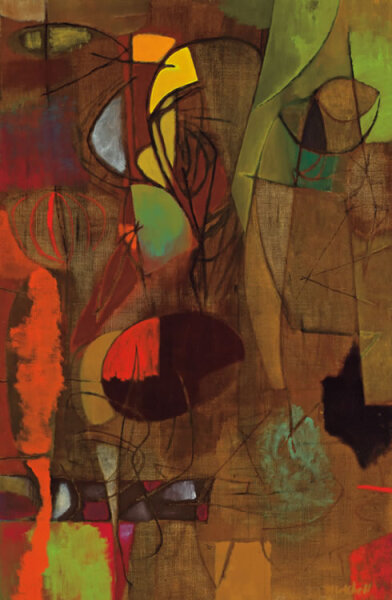
Tide Land
Fred Mitchell
1923-2013
Highly regarded by his fellow Abstract Expressionists, Madison Fred Mitchell Jr.—known to his friends as Fred—was at the center of the action in New York during the 1950s. Typically, his paintings are dynamic creations composed of soft-edged swatches of color.
Mitchell was born in Meridian, Mississippi, about ninety miles east of the state capital, Jackson. Attending the local high school, he was a radio announcer and captain of the band. His yearbook photograph shows him holding a brush and palette, and is accompanied by the statement, "Artist Fred Mitchell promises great things for the future, and has already proved that he is touched by genius." Following graduation and with a Scholastic Magazine art scholarship, during 1942/1943 Mitchell studied at the Carnegie Institute of Technology in Pittsburgh, Pennsylvania, until he was drafted by the United States Army in 1943. He spent his time in Maryland and Chicago, Illinois, where he taught mechanical drawing.
After completing his military duty, Mitchell was a student 1946–1948 at the Cranbrook Academy of Art in Bloomfield Hills, Michigan, where its first director "[Eero] Saarinen wanted students to be able to envision, create and understand all aspects of design, from architecture to furniture to metalworking, and to engage in experimentation." Mitchell spent the summer of 1947 at Columbia University in New York, where he worked with renowned printmaker Stanley Hayter at Atelier 17, before returning to Cranbrook Academy to complete his Bachelor of Fine Arts degree. He won an award of fifteen hundred dollars from the Pepsi-Cola Company which he used to travel to Rome and study at the Accademia di Belle Arti, 1948, 1950, and 1951.
In 1951 Mitchell settled in New York and the following year was one of the founders of the Tanager Gallery, one of the first cooperative galleries in the city; it functioned for a decade and offered an alternative to the upscale galleries on Madison Avenue. He was the first to live and have a studio at Coenties Slip in lower Manhattan, an area that emerged as a low-rent haven for contemporary artists who often frequented John Cage and Merce Cunningham performances. Among others, Jack Youngerman, Jasper Johns, and Robert Rauschenberg lived in a loft building a few blocks away. Actively involved with his peers, Mitchell became an authority on one of the central figures of Abstract Expressionism; in 1977 Mitchell organized a traveling exhibition Franz Kline: The Early Works as Signals in collaboration with the State University of New York at Binghamton.
In 1952, Mitchell founded the Coenties Slip School of Art, teaching in his studio until 1957, when he gave his lease to Robert Indiana. This initiated a robust and varied teaching career that included adult classes at the Riverdale Neighborhood House, 1952–1954, Finch College (a liberal arts college for women), 1952 and 1954, and a workshop in Positano, Italy, summer 1956. He returned to his alma mater, Cranbrook Academy and taught painting and drawing there 1955 to 1959, while earning his master's degree. Back in New York, he conducted classes at the Downtown Art Center, Seamen's Church Institute, 1961–1968, as well as at New York University, 1961–1971; Cornell University in Ithaca, New York, 1968/1969; Queens College and the City University of New York, 1973/1974; the Southern Tip School of Art, 1975–1975; Parsons School of Design master's program, 1979–1983; Kingsborough Community College, part of the City University of New York system, 1986–2000; and the Art Students League, 1985–2003.
Fred Mitchell