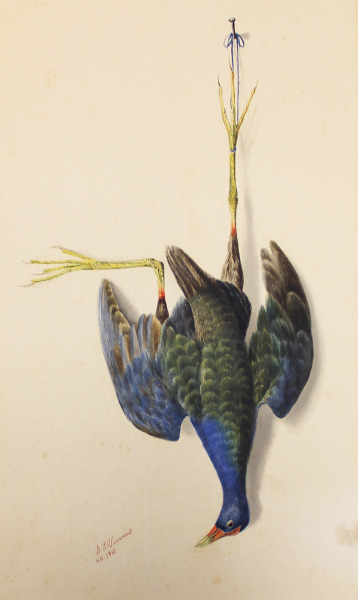
Nature Morte: Purple Gallinule
George Viavant
1872-1924
With their accurate color and precise details, George Louis Viavant's watercolors of bird, fish, and small wildlife become virtual scientific studies. Typically titled Nature Morte, a French term meaning still life, they partake of a long tradition dating to ancient Roman times. However, instead of being arranged on a tabletop, they hang vertically by strings, and are very "morte," in other words, dead.
Viavant was born in New Orleans, Louisiana, and lived there his entire life. He frequented his family's hunting camp as a child which instilled in him a passion for the wildlife he hunted and fished. His studies in art began at an early age at the Southern Art Union (later merged with the Arts Exhibition Club to form the Art Association of New Orleans), established in 1881 by local artists Andres Molinary, Marshall J. Smith, George David Coulon, and Bror Anders Wikstrom, among others. It also managed the first circulating public library in New Orleans, freely circulating over one thousand volumes.
Under the auspices of the Art Union, Viavant took lessons between 1884 and 1893 from Achille Perelli, an Italian immigrant who initially produced sculpture but turned to wildlife art, something which clearly influenced his protégé. Viavant was precocious; when he was twelve he won a prize at a local exposition. At the World's Industrial and Cotton Centennial Exposition (1884/1885) he was awarded a blue-ribbon for a landscape.
Unlike such earlier artist-naturalists as Mark Catesby and John James Audubon, both Perelli and Viavant did not position their subjects in active, although frozen, poses among appropriate vegetation. Nor did Viavant aspire to publication as his predecessors had done. Instead, Viavant painted fresh game directly from specimens that he or friends had captured, abundant near his residence in an eastern and rural section of New Orleans near bayous and Lake Pontchartrain. He was given a special license–a Scientific Collecting Certificate from the Department of Conservation–to collect specimens, which he painted in both oil and watercolor, excelling in the latter. His watercolor depictions of birds are some of his most valued works, prized for their detail and for the colors achieved in every individual feather.
George Viavant