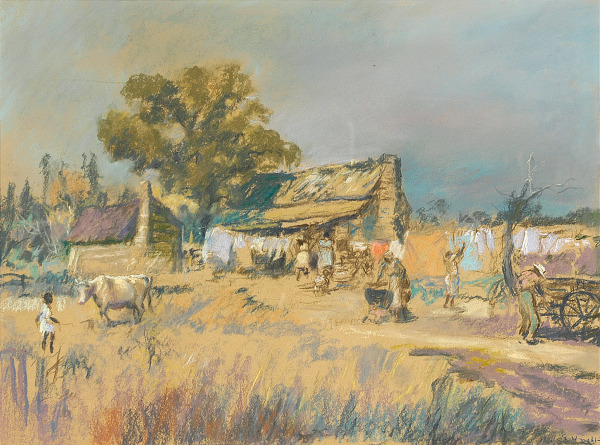
Wash Day
George Wright
1872-1951
A successful freelance illustrator during the heyday of illustration in the early decades of the twentieth-century, George Hand Wright was also an accomplished etcher and painter. He participated in several art clubs and societies and was an influential member of the art colony in Westport, Connecticut.
Wright was born in Fox Chase, an upscale neighborhood of Philadelphia, Pennsylvania. He was a Quaker and was orphaned as a child which forced him to live with relatives. He attended Spring Garden Institute (now Spring Garden College), a nearby private technical college. In 1890–1891 he took night classes at the Pennsylvania Academy of the Fine Arts and did odd jobs during the day. His primary instructor was the impressionist Robert Vonnoh and fellow students included Robert Henri and John Sloan, who are considered leading figures of the Ashcan School. For a short period Wright was an apprentice to a lithographer.
In 1893 Wright moved to New York City, where he was employed for a while at Tiffany & Co. That same year he produced his first of many illustrations for Scribner's Magazine. Other publications—Harper's Weekly, The Century Magazine, and The Saturday Evening Post—also used his illustrations which typically accompanied romantic stories. Many titles bear excerpts from dialogues and the women typically had the lithe, statuesque physiques of Gibson Girls. In 1901 he illustrated Norse Stories Retold from the Eddas by Hamilton Wright Mabie, a volume which has had many later editions and reprints, most retaining Wright's illustrations. Four years later he accompanied Royal Cortissoz, the noted art critic for the New York Herald, on a trip to Europe that included Paris, Germany, and Southern France. During World War I, Wright produced promotional posters for the United States Navy, often with patriotic titles such as Enlist in the Navy and follow the boys in blue for Home and Country and Hip Hip—another ship—another victory.
After visiting the artists/illustrators Edmund Ashe and John Marchand in Westport, Connecticut, Wright followed their example and settled there in 1907. It soon became a mecca for artists and he often made loans so newcomers could buy property. According to a 1924 headline in a local paper "Westport is Truly Getting to Be the Home of Many Famous Artists." The location was a convenient train ride into New York, but Wright also went further afield: he spent summers in rural Canada, and made frequent trips south in the wintertime. In 1915 he was in Beaufort, South Carolina, and probably nearby Charleston on the same trip. He also went to Savannah, Georgia; New Orleans, Louisiana, and Palm Beach, Florida, as well as Barbados. He traveled abroad in 1928.
In 1935 Wright was elected an associate member of the National Academy of Design and four years later became an Academician. The Library of Congress in Washington is in possession of 132 of his works on paper including posters, etchings, and sketches. In the 1930s and 1940s his work became more colorful evidenced by his use of pastels and an occasional oil.
George Wright