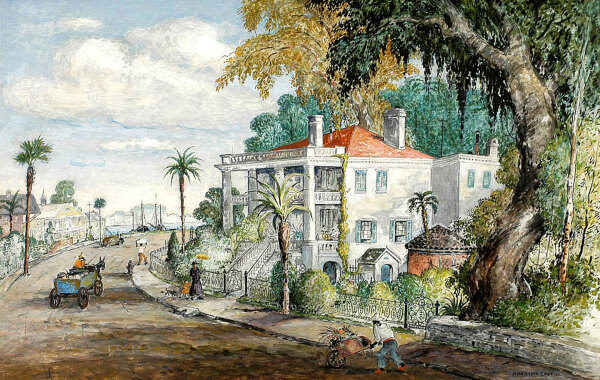
Road to the Harbor
Harrison Cady
1877-1970
Creator of the popular "Peter Rabbit" comic strip, Walter Harrison Cady's illustrations, including satirical cartoons and children's comics, were featured in publications such as Life, Burgess Bedtime Stories, Boy's Life, Country Gentleman, Good Housekeeping, Herald-Tribune Syndicate, Ladies' Home Journal, Saturday Evening Post, and St. Nicholas. As early as 1894 he was a published illustrator with an image in a supplement in Harper’s Young People. Reflecting his sense of humor, a lively mood pervades each of his illustrations and paintings.
As a child in Gardner, Massachusetts, Cady studied the work of artists such as Howard Pyle, Frederic Remington, W. A. Rogers, and A. B. Frost, and magazines, including Harper's New Monthly Magazine, Scribner's Magazine, St. Nicholas, and The Youth's Companion. His developing ability landed him an apprenticeship with Parker Perkins, a local painter.
When Cady was eighteen, he moved to New York City and found a job as an illustrator at The Brooklyn Eagle. Recognizing Cady's talent, the editor of Life Magazine, John Ames Mitchell, hired him as an artist and cartoonist. Cady remained with the publication until 1920. His art transitioned from the satirical cartoons that he produced for Life to children's stories when he began collaborating with Thornton W. Burgess in 1913. Thornton described Cady's work as "fantasy and friendly animals living in ethereal magical worlds." Some of Cady's most well-known drawings, including the character Peter Rabbit, appeared in Burgess Bedtime Stories, a daily newspaper created by Burgess. In the 1920s, Cady left the commercial art world to focus on his career as a full-time painter.
In 1931 Cady toured Europe for two months, visiting major cities like Venice as well as Arles and Avignon in southern France. His wife wrote to her mother-in-law: “So far I like Paris as a place to live better than any other city.… The shops, the museums with the great works of art.… Venice is filled with charm & great beauty & romance.”
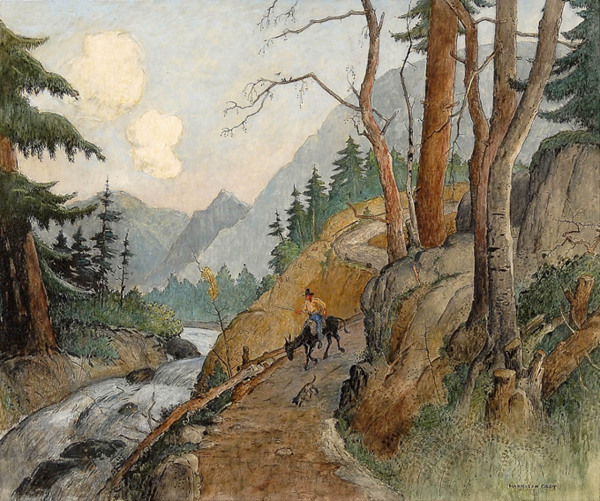
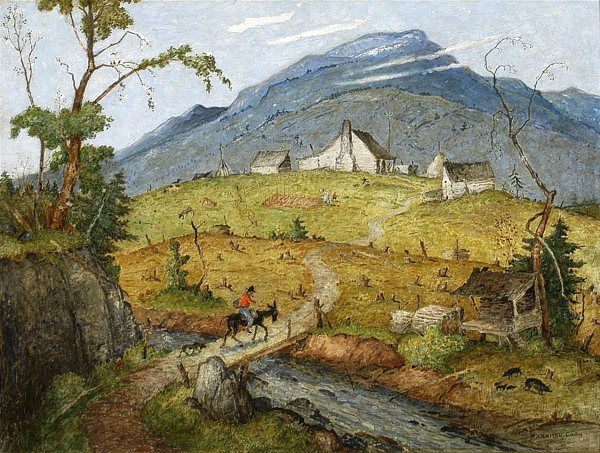
From the late 1920s to the 1950s, Cady sought picturesque locations that defied the onslaught of modernity. Some of his chosen locales can be viewed in his landscapes and genre scenes of Spruce Pine, North Carolina; Beaufort and Charleston, South Carolina; Savannah, Georgia; and New Orleans, Louisiana. He also greatly appreciated the beauty of the Appalachian mountain scenery of North Carolina, Virginia, and West Virginia. Cady's Southern art was shown at the Salmagundi Club's Spring Exhibition of 1950.
In 1920, Cady bought "The Headlands," a harbor-front estate in Rockport, Massachusetts, where he turned to oil painting, longing to be what he described as a "regular" artist. Cady focused his art on landscapes and marine subjects. He exhibited his work at the National Academy of Design and held membership with the American Society of Etchers and the American Watercolor Society. Cady had solo exhibitions at the Macbeth Gallery, participated in the New York World's Fair in 1938, and showed at Kennedy and Company until 1949. Examples of Cady’s work can be found at the National Museum of American Illustration in Newport, Rhode Island.
Harrison Cady
Harrison Cady
Harrison Cady