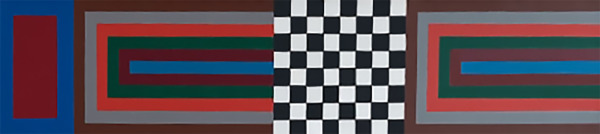
Untitled
Henry Pearson
1914-2006
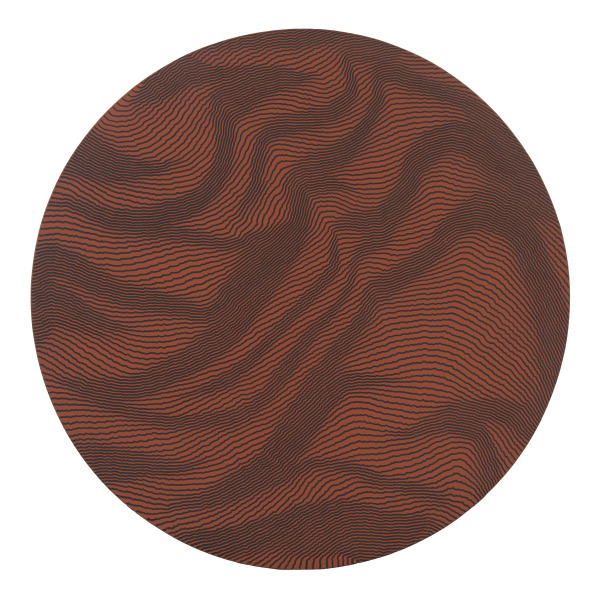
A designer of theater sets and a cartographer during World War II, Henry "Hank" Charles Pearson emerged as a pioneer of the Op Art movement of the 1960s. His artworks—prints and paintings—are methodical and calculated whether they consist of undulating lines or a checkerboard pattern.
Pearson was born in Kinston, North Carolina, located in the eastern portion of the state. Although he originally enrolled in the medical program at the University of North Carolina, Chapel Hill, he quickly realized his heart was in the arts and obtained his bachelor's degree in 1935. He then attended Yale University in New Haven, Connecticut, where he studied theater design and received his Master of Fine Arts degree in 1938. Between 1937 and 1942 he was a stage set designer; an extant scrapbook documents his role as technical director and scene designer during 1940–1941 at the Dock Street Theater in Charleston, South Carolina, which a few years before had undergone major renovations under the auspices of the Works Progress Administration.
In 1942 Pearson was drafted into the United States Army, where his background and skills were helpful in interpreting and designing topographical maps. One tour took him to Japan where he was involved in the Battle of Okinawa. Works from this time show Pearson's interest and experimentation in shkishi, traditional Japanese painting on small gold-edged boards, and sumi-e, illustrative paintings done in black ink. He was fascinated with Japanese culture and, in an effort to remain there, re-enlisted for another tour in late 1949. However, the Army Air Corps shipped him to Florida, where he spent the remaining years of his military service. He moved to New York in 1953 and studied at the Art Students League with Reginald Marsh and Will Barnet, who was working in an Abstract Expressionist mode that emphasized flat color. During this time, Barnet was also mentoring Judith Godwin and Mavis Pusey. Other artists that influenced Pearson were Kasimir Malevich and Piet Mondrian, two earlier artists who were admired by practitioners of Op Art for their interest in visual perception.
Pearson had a diverse and successful career. At some points, he taught at the New School of Social Research in New York (for thirty years) and the Pennsylvania Academy of the Fine Arts in Philadelphia. Plus, Pearson's work was included in the Museum of Modern Art's seminal 1965 exhibition, The Responsive Eye which served to define and showcase Op Art. His works from that period—including a few sculptures—consisted of parallel lines that moved rhythmically, and which resembled those found on topographical maps. Later he developed a form of geometric abstraction, and some works from that time bear titles derived from literature, like The Rime of the Ancient Mariner, or derived from ancient art such as the Lascaux cave paintings in France. This may have also been a pun on a brand of French paint with the same name. He also created a series of engravings based on prehistoric carvings for poems by Irish poet Seamus Heaney.
Henry Pearson
Henry Pearson