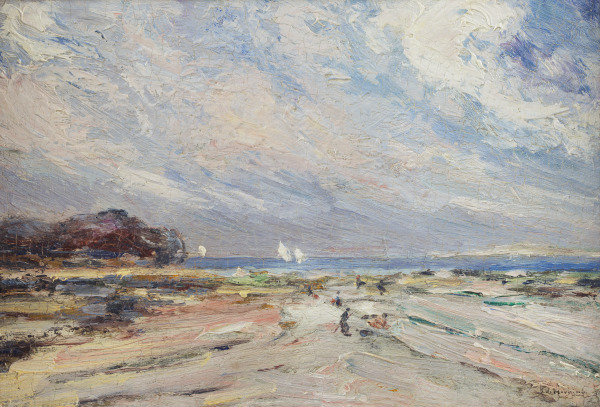
Beach Landscape
James Herring
1887-1969
A visionary leader in the development of African American art both academically and commercially, James Vernon Herring employed the curatorial process to define African American art at a time when the subject was neglected—or worse—dismissed altogether. Herring and his partner Alonzo J. Aden, a Black man from Spartanburg, South Carolina, co-founded the Barnett-Aden Gallery in a deeply segregated Washington, DC, in 1943. Until Aden's death in 1961, the Barnett-Aden Gallery offered a space for artists of color to exhibit their work during the difficult years between the Harlem Renaissance of the 1920s–1930s and the Black Arts Movement of the 1960s. Herring also mentored aspiring artists at Howard University, where he established an art department and gallery.
Born in Clio, South Carolina, James Herring was the son of an African American mother and White Jewish father. At the age of nine, he was sent to Washington where, it was hoped, the young boy would benefit from the educational opportunities available in the nation's capital and escape the threat of racial violence at home. This decision would be fortuitous and life changing. After attending Howard Academy (the university's preparatory school) and earning his bachelor's degree in pedagogy in art from the predominantly white Syracuse University in 1917, Herring began teaching in the department of architecture at Howard University in 1921. He did so with the intention of developing an art department, a feat he accomplished within a year's time. As the department's long-time director, he assembled a remarkable faculty—including Elizabeth Catlett, Loïs Mailou Jones, and James Porter, among others—and spearheaded the 1928 establishment of the university's art gallery.
Calm, regal, and always immaculately dressed, Herring led by example. His painting style, which recalls the light effects and broken brushwork of the late nineteenth-century French Impressionists, attests to his belief that artists should be free of racial aesthetic boundaries. This view placed Herring in direct contrast to the ideals espoused in the New Negro Movement founded by his Howard University colleague Alain Locke. While Locke contended that African American artists should pursue an exclusively African aesthetic, Herring encouraged a broader consideration of creative sources beyond, but inclusive of, African art. The roster of Howard students in the Herring era is stellar: Porter, David Driskell, Delilah Pierce, and Alma Thomas, to name just a few.
Aden, who had known Herring since taking his art history class in 1927, was the curator of Howard University Gallery of Art in the 1930s. In 1940, he was tasked with curating the American Negro Exposition, also known as the Black World's Fair. This landmark exposition was officially opened by President Franklin D. Roosevelt, with Herring as the Head of the Eastern Jury and Locke as Consultant. Highlighted in this exposition was the work of, among many others, Henry Ossawa Tanner, Robert Duncanson, Loïs Mailou Jones, Jacob Lawrence, Hale Woodruff, Charles White, Elizabeth Catlett, Richmond Barthé, Leslie Bolling, Edwin Harleston, Malvin Gray Johnson, Charles Alston, Bernard Goss, Rex Goreleigh, Palmer Hayden, Norman Lewis, Robert Neal, James Porter, Charles Sebree, Laura Wheeler Waring, James Wells, Ellis Wilson, Romare Bearden, Eugene Grigsby, Hughie Lee-Smith, William Artis, Selma Burke, Augusta Savage, Aaron Douglas, and Dox Thrash. Three years later, in 1943, Herring and Aden were able to mirror their academic and curatorial principles through the Barnett-Aden Gallery. Exhibitions there featured the work of contemporary African American artists, like Bearden, Barthé, and Woodruff; the gallery also showcased works by artists of color from around the globe, including Europe, Japan, Cuba, Africa, and South America. Traditional pieces were offered alongside modern abstract art forms, underscoring the curators' regard for established artistic traditions, while simultaneously nurturing divergence from those traditions. The gallery became an intercultural gathering spot for musicians, writers, politicians, and intellectuals in response to the painful racial and ethnic divides present in the greater Washington area.
As part of the educated and cultured bourgeoisie within the African American community—what W. E. B. Du Bois termed the "Talented Tenth"—Herring also sought to introduce the fine arts to Black communities beyond Washington, DC. In 1947, Herring visited vocational institutions throughout the South, assessing the need for art departments and exhibitions. Thanks to a Carnegie grant, Herring successfully developed the College Art Service in 1948. This program provided traveling art exhibitions to Black colleges and universities in the South until at least 1967.
James Herring's impact on African American art extends far beyond his own ouevre and entrepreneurship. His gift of a Wassily Kandinsky painting to his former student, David Driskell, initiated the younger artist's acquisition of a vast collection of African American art, now housed at the David C. Driskell Center at the University of Maryland. Robert L. Johnson, founder of Black Entertainment Television and owner of the historic Barnett-Aden Collection, donated several key works to the Smithsonian's National Museum of African American History and Culture in 2015.
James Herring