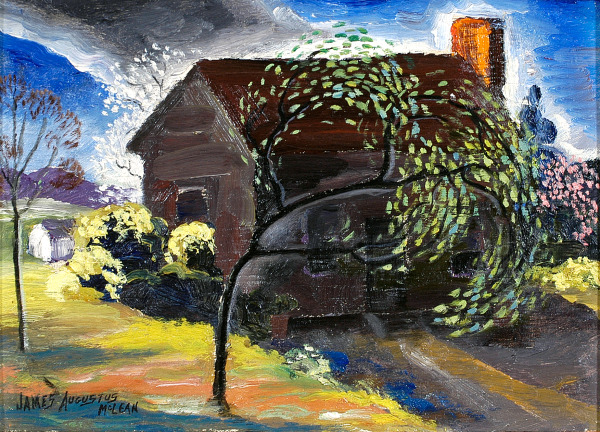
Country Cabin
James McLean
1904-1989
As a child, James Augustus McLean aspired to be an artist, and regretted that art was not taught in the local schools. Following his dream, he enrolled at the Pennsylvania Academy of the Fine Arts in Philadelphia, but decided to return home where he advocated for art education at all levels.
McLean was born in Lincolnton, North Carolina, thirty-six miles northeast of Charlotte, and the site of the first successful textile mill south of New England. During the academic year 1922–1923 he attended the University of North Carolina, Chapel Hill where the curriculum did not include art classes. When his father, a stonecutter, died in 1923, he was expected to start work in a cotton mill. After he learned through an advertisement that the Pennsylvania Academy of the Fine Arts arranged for part-time work for students lacking financial wherewithal, he sent in an application and a sketch. He was accepted and began with the Academy’s summer school in Chester Springs, Pennsylvania (now part of Historic Yellow Springs). He spent five years in Philadelphia and in 1926 he was awarded the prestigious Cresson Traveling Scholarship, which provided funds for him to travel that summer to Paris, Italy, Germany, and the Netherlands.
In his last year, the Academy offered him a teaching position, but McLean was persuaded by representatives from the North Carolina State Art Society to return home to start an art school. When it opened in Raleigh in fall 1929, the Southern School of Creative Arts had only one teacher: McLean. The timing was unfortunate; the stock market crash and the ensuing Depression led many students to leave. Nevertheless, he persevered and in 1930 even hired a dancer, Carrie Ann Simpson, whom he later married. He continued to advocate for art education and succeeded in convincing the local school system to offer classes in art; he also discussed similar courses at State College (now North Carolina State University) and at his alma mater the University of North Carolina at Chapel Hill, which in 1936 established an art history program with studio courses to follow.
During the Depression, McLean was involved in a number of New Deal programs. In 1934, under the auspices of the Civil Works Administration (a job creation initiative preceding the Works Progress Administration), he painted four murals for the library at State College. He was permitted to choose the topics, and later explained. “I decided to do the murals on the four main subjects taught at State at the time: engineering, architecture, agriculture, science. I went to the department head of each of these subjects to get the information on what each mural should have in it that would be representative of the subject. [The faculty at State College] were very pleased with the idea … at first.” But not everyone was thrilled by the end result. One outspoken alumnus and several faculty members felt the paintings were too modern for the Victorian style rotunda. The murals were removed in 1941 to a storage area and, sadly, not cared for, except for one which was rescued and placed in the student center in 1982. In an article describing their installation, McLean commented “They’ve come to the conclusion that the murals were good and that I was treated badly.”
Mclean’s other murals in North Carolina did not generate the same kind of controversy. With support from the Works Progress Administration (WPA) he completed two murals, Energy and Education, for the Grimsley High School in Greensboro. For the Charles A. Cannon Memorial Library in Concord, he created a twelve by fifty-two foot painting depicting Historical Highlights of Cabarrus County. In 1941 it was installed with much fanfare in the community center in the Confederate Memorial Hall, which included the library. Its initial location explains the emphasis on the Civil War which dominates the central portion, as well as the fact that it reads from right to left because of where one entered the hall. In 1976 the mural was moved to a new library building where it remains.
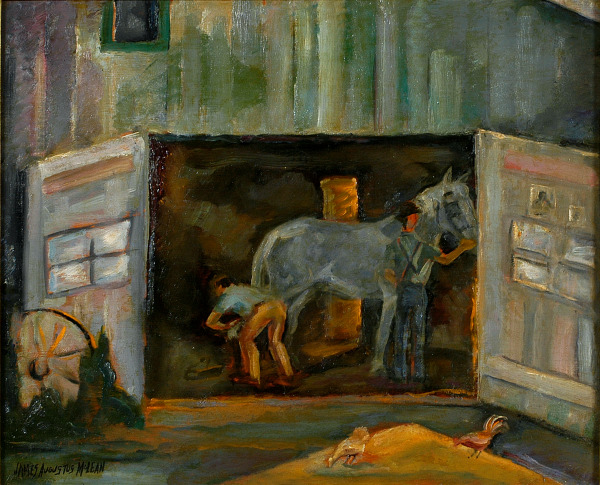
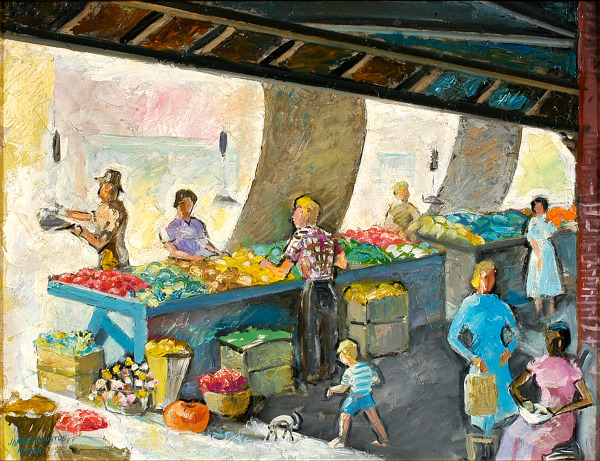
Under the WPA’s Federal Art Project (FAP) McLean supervised the programs at the Raleigh Art Center, the first community art center to inaugurate an important component of FAP. It opened in May 1936 and was first housed in a converted store; later it moved to a high school. Mclean was also involved in the Raleigh Little Theatre, est. 1936, affiliated with the Federal Theatre project. McLean maintained a studio in the theater’s first building. He painted scenery for school productions and six of his paintings were used in Hollywood movie sets. In addition to his large-scale work—murals, scenery—he worked in watercolor and oil on a more modest scale, often depicting rural scenes in a straightforward manner that resembled his realistic mural style.
James McLean
James McLean
James McLean