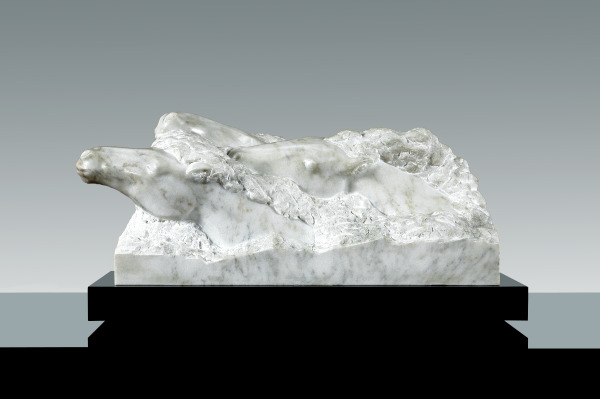
Wind Runners
Jane Armstrong
1921-2012
Although she did not discover sculpture until her forties, Jane Taylor Botsford Armstrong was quite proficient at carving many different kinds of stone. Her passion for horses and cats is reflected in her many depictions of them emerging from a block of marble or alabaster. She felt that "each piece of stone has its own magic and reward—and also its unique characteristics and challenges in carving."
Armstrong was born in Buffalo, New York, and was adopted and raised by the Botsford family. She attended Buffalo Seminary, a private college preparatory school for girls. The headmistress had a habit of giving each student the name of a flower; since Armstrong had an impulsive disposition, the headmistress described her as "a flower on the edge of the garden leaning out." From there Armstrong went to Middlebury College in Vermont, but left after a short period with the excuse it had no art department. She went instead to the Pratt Institute in Brooklyn, New York.
Returning to Vermont, Armstrong taught music and art for a few years in one-room school houses in a region known as the Northeast Kingdom because of its rustic beauty and grandeur. From being an art teacher, she transitioned to being a reporter, first for the Rutland Herald, then with the Burlington Free Press. She then joined the staff of the Journal of Commerce, which covers global trade, and Chemical Week, a McGraw-Hill publication focusing on the chemical and petrochemical industries. In this capacity she interviewed corporate executives and traveled abroad.
In 1964 Armstrong visited the sculpture classrooms of the Art Students League in New York, at which point she decided to enroll as a student of José de Creeft, who was highly regarded for his emphasis on direct carving. de Creeft once said of her: "This girl, she works too hard." After completing her studies, she moved to Manchester, Vermont, and worked in a studio called High Meadows. The state was an ideal location for a marble sculptor, as Vermont is home to the world's largest underground marble quarry, Danby quarry, from which Danby marble gets its name. She was a frequent exhibitor locally and elsewhere in New England and sometimes had a sign saying "please touch" accompanying her pieces which weighed as much as four hundred pounds. It was for this reason that her work had a "special appeal for the blind." Armstrong also spent time in Highland Beach, Florida, and later maintained a studio in Saluda, North Carolina. She had several exhibitions across the South: at the North Carolina Museum of Art, Raleigh in 1974, the Columbia Museum of Art in South Carolina in 1975, and at the Arkansas Art Center in Little Rock and the Columbus Museum of Art in Georgia in 1976. In 1979 her book, Discovery in Stone was published.
While her forte was carving animals—a reflection of her keen interest in the environment—on occasion she created abstract works. In 1991 she shared her philosophy in the following artist's statement: "Carving stone has special meaning for me. After thirty years of carving marble I am still drawn to a particular piece by its veining, shear lines, fissures and fossils which tell the unique history of that stone. I try to respect and preserve these special characteristics, harmonizing them with the lines and mass of my subject, often removing as little stone as possible in order to emphasize the importance of the original block." Late in her career as her eyesight began to fail she gave up stone carving because she could no longer sculpt in the "finished, flawless" manner that she said she desired. From then on, she modeled clay pieces that were cast into bronze, but her attachment to the stone works still remained. Speaking on an installation of one of her pieces at a new local luxury hotel, she stated that she felt "very lucky" to have a piece "here where [she could] touch it."
Jane Armstrong