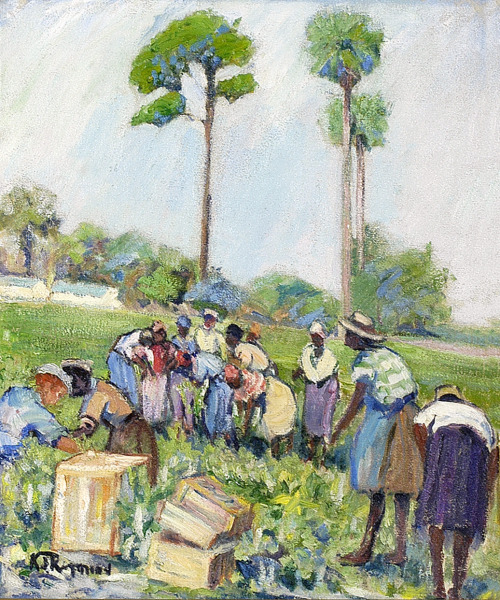
Celery Pickers
Kathryn Raymond
1863-1943
A few extant paintings by Kathryn (Kate) Tileston Raymond suggest that she began as a Realist and rather academic painter who later embraced Impressionism. She was a resident of the Boston, Massachusetts area until late in life, except when she studied in New York or traveled abroad.
Raymond was born in Somerville, northwest of Boston and north of Cambridge. In her teens she was living about ten miles away in Newton at an address that indicates her family was affluent. In 1894 she traveled first class to England; on her passport application she noted that she was an artist and was both a student and a resident of Boston. Either on this trip or subsequent ones she stayed at the American Girls' Art Club in Paris where room and board, a library, and interactions with other women artists such as Anne Goldthwaite were provided.
In the historic Boston neighborhood of Back Bay, Raymond was affiliated with the Grundmann Studios, a structure that featured artists' studios and multipurpose activity spaces such as Copley Hall. Several important events took place in that space, which may have influenced Raymond's change of palette, paint application, and subject matter. The first was an exhibition of John Singer Sargent's work in 1899, followed in 1905 by one focusing on Claude Monet. In 1913 Copley Hall also hosted the controversial Armory Show which, in addition to the Modernist pieces it was known for, showed work by Monet, Camille Pissarro, Pierre-Auguste Renoir, along with the American Impressionists Theodore Butler, Childe Hassam, and John Henry Twachtman.
In 1899 Raymond received a mention in Brush and Pencil, a noted art publication of the day about one of her watercolors: "Another painter who uses colors, but gently and in good tone, is Kathryn Raymond of Boston. …'Tis a pretty composition and the artists like it. The paint is in simple wash and a bit dry in effect." In 1905 she was awarded a scholarship for one tuition-free year at the New York School of Art for her work in portraiture. Notable Impressionist painter William Merritt Chase was the primary instructor. The artists George Bellows and Edward Hopper received scholarships that same year. Raymond went abroad again in 1913 when she was fifty. Records of another trip two years later reveal that she spent time in France as she sailed from Bordeaux. The 1920 census lists her as a resident of Brookline, and her occupation as "portrait artist." Raymond left the northeast before 1940, at which point the census described her as a "wanderer" who stayed at the boutique West Coast Hotel in Clearwater, Florida. The surrounding area provided her with scenic subject matter that was largely agricultural, with an emphasis on citrus and celery. She died in Clearwater in her eightieth year.
Kathryn Raymond