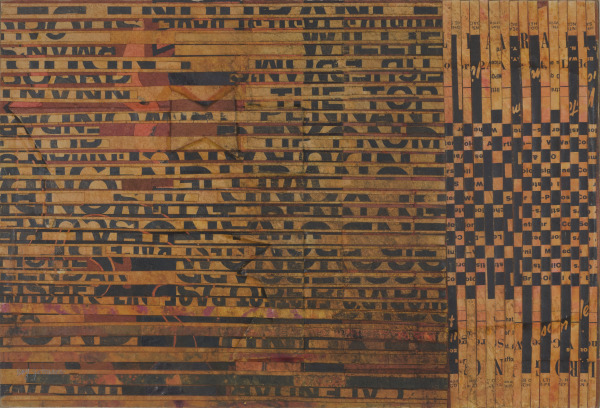
Untitled
Ray Johnson
1927-1995
Considered both a Pop and conceptual artist, Raymond Edward Johnson, known as Ray, has been labeled an enigmatic prankster and a pioneering genius of mail art. His origins and childhood in working-class Detroit, Michigan, were ordinary enough. He attended Cass Technical High School, an occupational school where he focused on commercial art. He also took classes weekly at the Detroit Institute of Arts, and spent a summer at the Ox-Bow School in Saugatuck, Michigan, an affiliate of the Art Institute of Chicago.
In the summer of 1945, he headed east to study at Black Mountain College near Asheville, North Carolina, where he spent the next three years (with the exception of spring 1946 when he was in New York studying at the Art Students League). Among his instructors at the experimental college was Josef Albers whose courses on art materials proved highly influential. In addition, Johnson befriended many avant-garde artists, including fellow student Robert Rauschenberg, and teachers Robert Motherwell, John Cage, Merce Cunningham, all of whom emphasized various forms of improvisation.
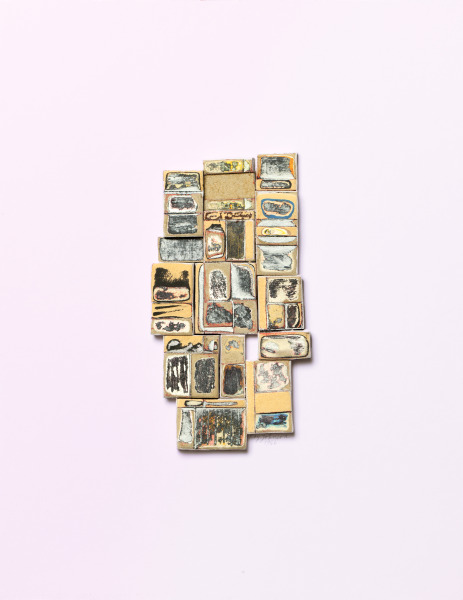
In early 1949, Johnson moved to New York. There, he joined the American Abstract Artists group and painted geometric abstractions that reflect the teachings of Albers and Ilya Bolotowosky, another faculty member at Black Mountain. Four years later, however, Johnson abandoned this direction and took up collage, building layered compositions from fragments of popular culture such as celebrity photos and cigarette packaging. He coined the term "moticos" (an anagram for osmotic) for a number of small things he made. His small collages, which he mailed to friends with the instructions to "please add to and send to" additional recipients, were comprised of magazine clippings and other advertisements pasted on cardboard. He also displayed his work on the streets of New York, trying to engage puzzled passersby. When one client asked for a twenty-five percent discount, Johnson obliged and delivered the piece with a quarter cut off. Between 1957 and 1963, he participated in various performance events, often titled "Nothings."
Unnerved after being mugged at knifepoint and shaken by the death of Robert F. Kennedy, in 1968 Johnson moved to Glen Cove on Long Island and began a reclusive existence which he described as a "mysterious and secret organization." Later he moved to nearby Locust Valley. Though physically removed from the modern art scene, he maintained personal and cultural connections through his mail art, over one hundred examples of which were featured in a 1970 exhibition, The New York Correspondance [sic] School, at the Whitney Museum of Art.
In 1976 he inaugurated his silhouette project which consisted of two hundred profiles of friends, artists, and celebrities which served as the basis of his collages. Another undertaking from the early 1990s consisted of using disposable cameras to capture collages that he placed in ordinary settings like parking lots, cemeteries, beaches, and sidewalks. Johnson's suicide at age sixty-seven—he dove off a bridge in Sag Harbor into frigid waters—has been interpreted as his last piece of performance art. Johnson's work is represented in leading museums, including the Detroit Institute of Arts, the Los Angeles County Museum of Art, the Museum of Modern Art, and the National Gallery of Art.
Ray Johnson
Ray Johnson