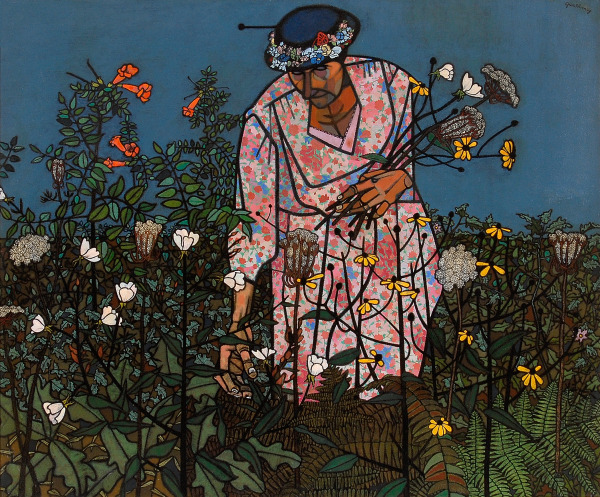
Flowers for the Pulpit
Robert Gwathmey
1903-1988
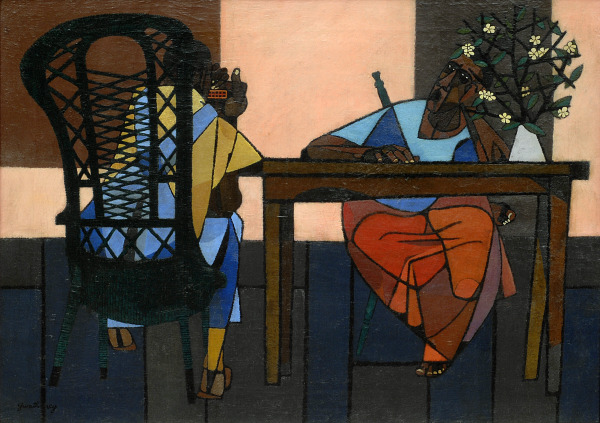
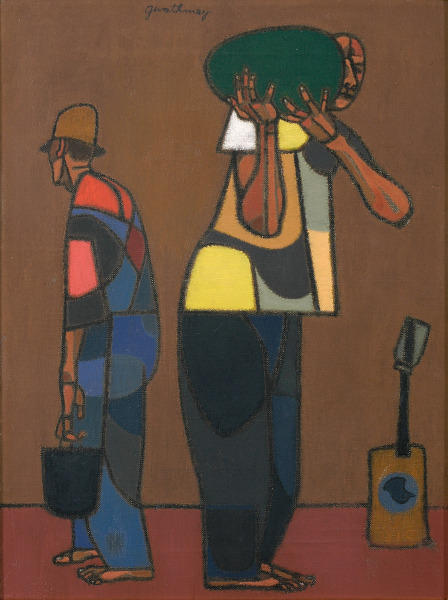
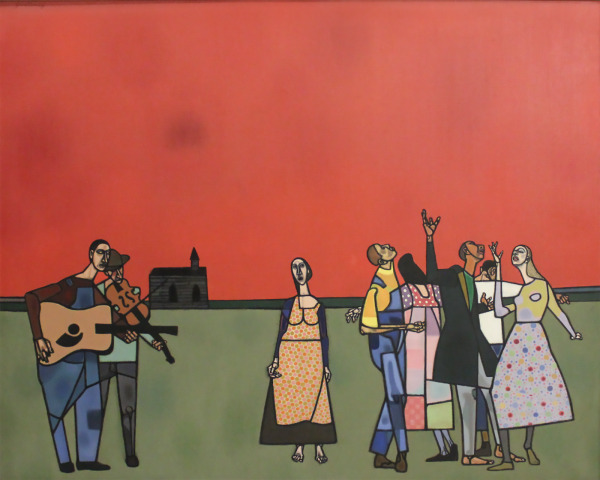
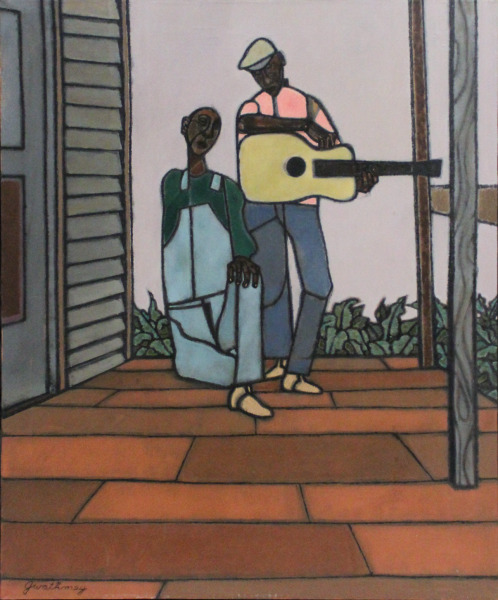
Over his lengthy and distinguished career Robert Gwathmey focused on themes of poverty, hunger, and prejudice. Using familiar stereotypes and well-established symbols, he attempted to raise social awareness. He stated: "I believe that in painting the use of limited imagery is the best method of presentation of your content. I believe that if the symbols are strong enough, they transcend the literary in painting."
An eighth-generation Virginian, Gwathmey was born in Richmond. After high school, Gwathmey studied briefly at North Carolina State University in Raleigh and then spent a year at the Maryland Institute for the Promotion of the Mechanic Arts (now the Maryland Institute, College of Art) in Baltimore. During the summer of 1925, he worked his way to Europe on a freighter and upon his return he studied at the Pennsylvania Academy of the Fine Arts in Philadelphia between 1926 and 1930. He prospered and was awarded two William Emlen Cresson Memorial Traveling Scholarships which he used to return abroad during two summers. He was enthralled by Gothic art and architecture, and with stained glass in particular. Later in his career, his signature style was austere with sharp outlines, bold patterns, and flat modeling, inspired by what he had seen in the great European cathedrals.
After graduating from the Academy in 1930, Gwathmey briefly taught art at Beaver College, a small women's college (now Arcadia University) located in Glenside, a short distance north of Philadelphia. Beginning in 1938 he held a position at the Carnegie Institute of Technology in Pittsburgh. By then he was already an active member of the Artists Union, a progressive organization which advocated for social change and ultimately led to the establishment of the Federal Art Project, a component of the Works Progress Administration. In 1941 Gwathmey painted a mural for the post office in Eutaw, Alabama, which is titled The Countryside and depicts a scrawny cow and four African Americans in overalls working to raise tobacco.
Subsequently Gwathmey settled in New York City and in 1942 he started to teach evening and Saturday classes at the Cooper Union School of Art in Manhattan where he remained for twenty-six years; Merton Simpson was among his students there. Within two years of his appointment, he received a Julius Rosenwald Fellowship and used it to live and work with Black tobacco farmers in North Carolina for two summers. His reaction to those summers and regular visits home to Virginia was potent: "I was shocked by the poverty. The most shocking thing was the Negroes, the oppressed segment. … I was shocked at the red clay, the redness of the clay."
Southern sharecroppers were Gwathmey's primary subject, and they are usually portrayed with gaunt physiques and bent posture in spare landscapes. His best known works are characterized by simplified forms, tight compositions, strong outlines, and patterning, an approach he shared with his friend and traveling companion Claude Howell. Upon occasion Gwathmey was called "the white Jacob Lawrence," which he did not mind as he was on good terms with the well-known Black artist. Another artist with whom Gwathmey was friendly was Ben Shahn; they shared similar views on social justice, and both were investigated by the Federal Bureau of Investigation.
In 1968 Gwathmey retired from teaching and took up residence in Amagansett on the eastern end of Long Island, New York, in a modernist studio and home designed by his son Charles, a noted architect. His paintings and silkscreens became less politically charged, although still symbolic, with more emphasis on nature and still life. In 1975 he was elected a National Academician at the National Academy of Design and was also a member of the American Academy of Arts and Letters. His work is included in many public and private collections throughout the United States, including the Smithsonian Museum of American Art; Museum of Fine Arts, Boston; the Philadelphia Museum of Art, and the Whitney Museum of American Art. When asked to describe his philosophy of art, he responded: "I think of the artist as the rounded man, working free of compromise and constantly seeking the meaning of his work and his society. … I like to tell a story and I want it to be understood. … No work of art can possibly exist without the exploration of the formal and aesthetic qualities. It is the fusion of this with the subject matter that gives an art totality."
Robert Gwathmey
Robert Gwathmey
Robert Gwathmey
Robert Gwathmey
Robert Gwathmey