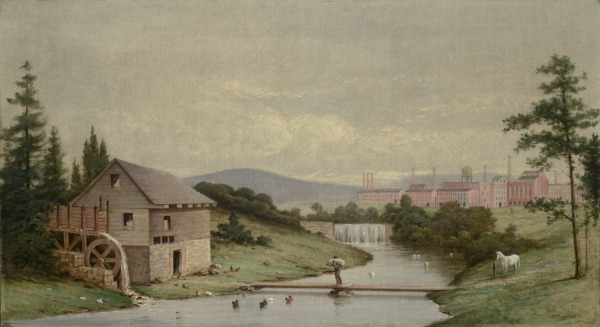
Tenn. Mill and Mine
Thomas Campbell
1834-1914
As his gravestone in Tennessee attests, Thomas Campbell had two callings: “Presbyterian minister and artist noted for his pastoral scenes of east Tennessee and picturesque views of Europe.” His birthplace was Beverley in the East Riding of Yorkshire in northern England, a market town in a largely agricultural area. Three years of his childhood were spent in Ireland before he immigrated to the United States at age nineteen.
Sources vary on where he attended college; his obituary states he was a student in Burlington, Iowa, where Burlington University emphasized the classics, but an annual report from Maryville College where he later taught includes the following statement: “he graduated in 1860 from Yellow Spring [sic] College” with a Bachelor of Arts. However, the archives at Antioch College in Yellow Springs, Ohio, have no record of his attendance there. Campbell proceeded to the Auburn Theological Seminary in Auburn, New York, established to prepare clergy for the American frontier. Much later it moved to the campus of the Union Theological Seminary in Manhattan. He graduated in 1865.
In 1863 Campbell married a native of Lyons, New York and three years later he was ordained by the Presbytery of Cayuga in Syracuse; he held ministerial positions in Sennett, New York and Camp Point, Illinois where a daughter was born in 1865. For twenty-three years he was a pastor in Minnesota at Shakopee and Le Sueur, both southwest of Minneapolis, where he spent part of his time ministering to indigenous peoples.
In pursuit of a better climate for his ailing wife, in 1891 Campbell moved to the Knoxville area of Tennessee and eventually retired from the ministry and instead devoted himself to painting. He taught art at Maryville College (1893–1894), a Presbyterian college founded in 1812 and situated in the foothills of the Smoky Mountains south of Knoxville. According to his obituary he spent two years in Europe, “studying and painting in the galleries of Rome, Paris, and other art centers. … He gathered much of his inspiration from nature, and his canvasses reflected her many moods; under the sunny skies of Italy; among the heathen hills of Scotland, France, the Adirondacks, the prairies, the western mountains and our beloved East Tennessee. He caught the exquisite atmosphere of each, and with a wonderful realism.” The 1900 census documents his residence in Knoxville and in 1902 he returned to Maryville College where he founded the art department, teaching there until his death.
According to some sources, in addition to oil paintings Campbell did china painting and woodwork, in particular frames. The subjects of his canvases are typically rural scenes, often landscapes with farmhouses, but few figures. Tenn. Mill and Mine juxtaposes a grist mill—identifiable by the figure carrying a sack across a modest bridge—against an imposing complex of brick structures, probably in Knoxville, where in the 1880s almost one hundred factories opened, bringing an influx of textiles, iron, and food to the region. Paintings by Campbell can be found in the collections of the Knoxville Museum of Art, and in Nashville, the Tennessee State Museum and the East Tennessee Historical Society.
Thomas Campbell