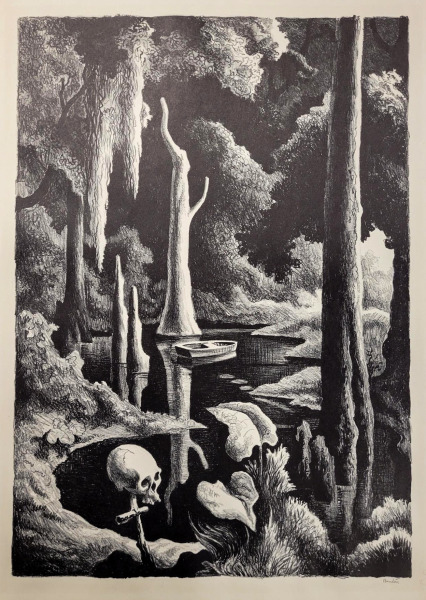
Swampland
Thomas Hart Benton
1889-1975
Although Thomas Hart Benton is best remembered as a leading figure of American Regionalism and a chronicler of Midwestern life, the people and landscapes of the American South were equally important to his artistic vision. During the 1920s and 1930s, Benton traveled extensively throughout the country, seeking subjects that reflected the experiences of ordinary Americans. His journeys through the rural South introduced him to agricultural communities, distinctive regional traditions, and the rhythms of daily labor that would become recurring themes in his paintings.
Born in Neosho, Missouri, Benton grew up in a politically prominent family. His father, Maecenas Eason Benton, served as a United States congressman and hoped his son would pursue a similar career. Benton instead enrolled at the Art Institute of Chicago in 1907 and subsequently traveled to Paris, where he studied at the Académie Julian and lived along side emerging Modernists including the muralist Diego Rivera. Returning to the United States in 1912, he settled in New York and gradually abandoned abstraction in favor of a distinctly American narrative style. By the 1920s, Benton had developed the energetic compositions, exaggerated figures, and undulating landscapes that would characterize his mature work.
The artist's travels across the South provided subjects that complemented his interest in American history, industry, and rural life. Working from sketches made during his journeys, he portrayed agricultural workers, musicians, and communities whose experiences were often overlooked in mainstream American art. Works such as Ploughing It Under from 1934, based on a South Carolina agricultural scene, and Swampland (1941), inspired by the Louisiana wetlands, reflect his interest in what became known as the American Scene.
Benton's influence on Southern art extended beyond his own depictions of the region. As an instructor at the Art Students League in New York, he taught a generation of artists who would develop distinctive approaches to Southern subjects. Among them were John McCrady, Joseph Delaney, Beauford Delaney, and Palmer Schoppe. While each pursued an individual artistic direction, their encounters with Benton contributed to a broader dialogue about American identity, regional experience, and the representation of everyday life. McCrady and Schoppe, in particular, incorporated aspects of Benton's expressive figuration and narrative compositions into their portrayals of the South.
Benton's commitment to representing American experiences also shaped his career as a muralist and educator. His monumental murals, including America Today and A Social History of the State of Missouri, brought national attention to his distinctive style and his belief that art should remain accessible to a broad public. In 1935, he returned to Missouri to teach at the Kansas City Art Institute. Although the rise of Abstract Expressionism diminished the popularity of Regionalism after World War II, Benton continued to paint recognizable American subjects throughout his life. His portrayals of the South and his influence on artists working within the region remain significant expressions of his enduring interest in the relationship between people, labor, and the American landscape.
Thomas Hart Benton

Thomas Hart Benton