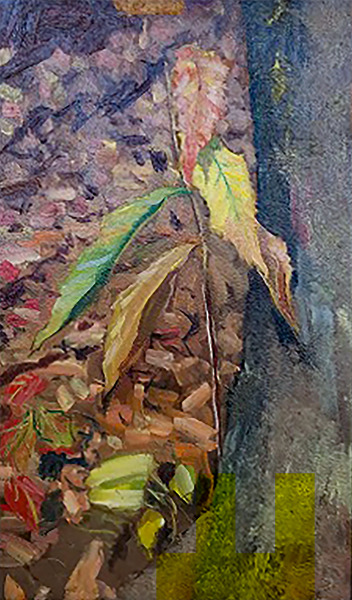
Still Life (Chestnut Sprouts)
William Kendall
1869-1938
Portraits along with portrayals of his wife and daughters served as the main subjects for William Sergeant Kendall. He also painted landscapes and studies of nature which were less demanding and less time consuming; in 1915, after painting outdoors for a while, he complained “I was nearly eaten alive by mosquitoes.” In addition, he produced a number of plaster sculptures.
Kendall was born in Spuyten Duyvil, at the time a middle class, tree-lined neighborhood in the Bronx, New York. Precocious, he was painting at age twelve and signed his work “Sergeant Kendall,” dropping his first name. He spent part of his childhood in Brooklyn and enrolled at the Brooklyn Art Guild when he was fourteen. His instructor there was Thomas Eakins, whom Kendall followed to the Pennsylvania Academy of the Fine Arts in 1884. The young artist wrote to his parents: “Eakins came in today and criticized my work. He said my work ‘was not bad’ which as you know is good praise for him!”
In 1886 Kendall returned to New York and took classes at the Art Students League with James Carroll Beckwith and Henry Siddons Mowbray, both primarily figurative painters. Two years later Kendall departed for Paris and began three years of study at Académie Julian. Escaping the French capital in the summertime he painted in southern Brittany, in Le Pouldu and Concarneau where his subjects were Breton peasants, mostly women. One of his canvases received an honorable mention at the prestigious Paris Salon. In 1891 Kendall set out for Madrid because he wanted to copy paintings by Diego Velasquez, whom he considered to be the first modern painter.
Back in New York, between 1892 and 1895 Kendall taught painting classes for women at the Cooper Union (originally called The Cooper Union for the Advancement of Science and Art). In 1901 the National Academy of Design elected him an associate member, and four years later a full academician. Kendall’s income was derived largely from portrait commissions; for a full-length likeness he received $4,000 and $1,500 (valued at $135,000 and $50,000, respectively, in 2025) for just a head. He left New York, moving in 1910 to live in Newport, Rhode Island, and then he went to New Haven, Connecticut where he became a professor and head of the Yale School of Fine Arts (now the Yale School of Art) fulfilling that position from 1913 to 1922. He spent the summers of 1918–1920 in Brattleboro, Vermont, along the Connecticut River. He resigned from Yale after his involvement with a younger female student was revealed; he had divorced his wife earlier, and subsequently remarried.
In 1923 Kendall settled in Hot Springs, Virginia, a historic resort area located in the Appalachian Mountains. He built Garth Newel—a Welsh phrase meaning “new hearth” or “new home”—which included a three-story residence with wings and stables where he raised Arabian horses. In 1935 he went to France for a visit, and returned to his Virginia retreat and died after several riding accidents.
William Kendall