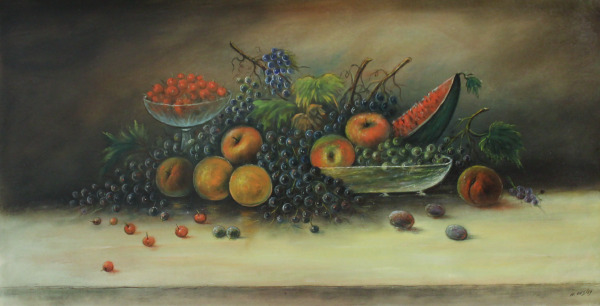
Still Life of Grapes, Peaches, Apples, Plums, Watermelon and Cherries
William Ousley
1866-1953
A self-proclaimed poet and oddball, painter William Cole Ousley (known also as Bill, Will and Willie) used to revel in the visitors who came to his studio in West Fork, on the banks of Louisiana’s Calcasieu River, a popular place for fishing and boating. The picturesque location was the inspiration for the majority of his many paintings. Expressing an interest in painting at an early age, and largely self-taught, Ousley indicated later that he “never had money to buy paints and brushes.” While he might have been too poor for materials as a child, his proclivity would soon make him a successful artist. The date of Ousley’s birth in Marietta, Georgia, is disputed, variously given as 1866 and 1870. As a child, he was sent to live with other families and with one of them he moved to the neighborhood of Bagdad, in Grant Parish, Louisiana in 1876. He worked as a sign painter and wallpaper hanger, receiving direction from Paul Sullivan of the enterprise Sullivan and Castello in New Orleans. Ousley also seems to have gotten instruction from P.A. Wayne, a painter and decorator of churches.
In 1890 Ousely began to work under Erasmus Humbrecht, a Swiss-trained church painter who at the time was repainting some of his earlier work in the St. Louis Cathedral in Jackson Square, New Orleans. Under Humbrecht’s influence, Ousley painted a limited number of very controlled and realistic fruit still lifes. His mentor told his assistant: “You will be a great artist someday.”
Leaving the Crescent City, Ousley took up residence in West Fork, northwest of Lake Charles on the banks of Calcasieu River. He depicted the riverbanks in every season and at various times of day, including under moonlight. The resultant imagery is romantic and aligns with his desire to restore the area’s natural beauty which had been devastated by sawmills. He was inventive, describing his process like so: “I’d take the bluing from the wash, the soot from the stove, berry juice, chalk—just anything that I could get, make my colors [sic]. For my brushes, I’d use the tails of squirrels. And they made good brushes, too!” Ultimately he turned to more traditional materials and was prolific; it has been estimated he created two thousand paintings. In a 1929 newspaper article, he was quoted as saying: “I have been called a natural born artist all my life, but the only natural part is stickativeness and bulldog hangonitism.” Through some lucky circumstances, a painting he had shown at the Beaumont, Texas Fair was purchased by someone who sent it to Eleanor Roosevelt, and in turn she sent Ousley a thank you note.
Ousley was married three times and had six children. In his “spare” time, he hunted, painted, wandered the land, and played music on his fiddle, often entertaining visitors to his studio. A lover of poetry, Ousley often inscribed the versos of his paintings. A painting of a cypress tree has the following written on the back: “For an artist or Poet I would Be. When I look at the Beauty Of a Monarch Tree. Yours Trooly. Uncle Bill The Artist.”
William Ousley