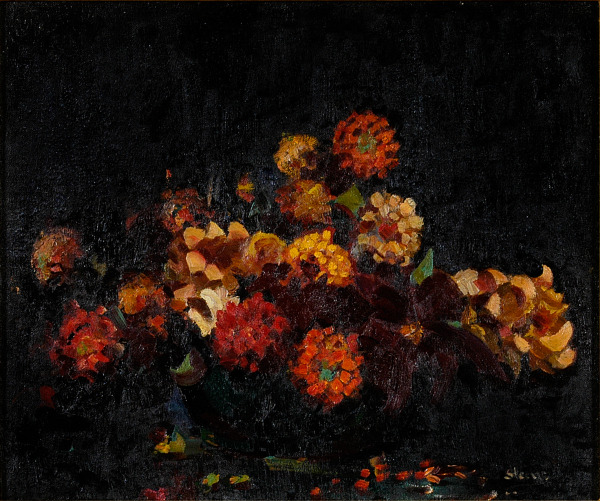
Still Life
William Steene
1888-1965
A traditional Realist, William Robert Steene painted a diverse range of subjects, but is best known as a portraitist. It is said that he undertook some four hundred portrait commissions in addition to several murals in the South.
Steene was born in Syracuse, in upstate New York, and grew up in Middletown City, located in the Hudson River valley closer to New York City. He was precocious and began selling paintings at age sixteen, and worked at the Syracuse Museum of Fine Arts in various capacities by the time he was eighteen. He studied with Robert Henri at the Art Students League and at the National Academy of Design, both in Manhattan. Like many aspiring American artists, he continued his training in Paris at the Académie Colarossi and the Académie Julian.
The academic training Steene received served him well as a portraitist and as a muralist and he moved around the country in pursuit of commissions. He met his wife, actress Eula Jackson, in New York, while painting theatre scenery and enjoying the occasional theatrical role himself. His 1917 draft card was submitted in Tulsa, Oklahoma, and listed him as an artist. A newspaper article dated 1919 listed him as accepting commissions in Fayetteville, Arkansas. The sitters of Steene’s paintings were distinguished individuals and their portraits trace his itinerary throughout the country. Dr. Karl Meyer, head of the Cook County Hospital in Chicago, Illinois; Dr. Harry Woodburn Chase, president of the University of Illinois, and Frank Logan, the honorary president of the Art Institute of Chicago. Wofford College in Spartanburg, South Carolina commissioned Steene to paint portraits of Walter K. Greene and Henry Nelson Snyde, former presidents. Steene also painted several Mississippians: Senator Theodore Bilbo and Governor Harry Whitfield. His visit to Biloxi in 1931 resulted in a long-term relationship with the Gulf Coast, where he resided for the last fourteen years of his life. His nationally-known sitters included President Franklin Delano Roosevelt and golf legend Bobby Jones.
In 1922 Steene painted a twelve-by-sixteen-foot World War I memorial in honor of fifty-five deceased students at the Agricultural and Mechanical College of Mississippi (now Mississippi State University). The size and style followed that of an Italian Renaissance altarpiece. Beginning in the early 1920s and lasting through the 1940s, Steene and his family began living on-and-off in Tryon, North Carolina, a well-known artist’s community in the mountains. In 1930 Steene moved to Chapel Hill, North Carolina, for a year to work on a large mural for the North Carolina Legislature Building in nearby Raleigh. It portrayed The Baptism of Virginia Dare on Roanoke Island; Virginia Dare was the first English child born in an American colony. In 1956 for New Orleans’s historic Presbytère building in Jackson Square (now part of the Louisiana State Museum) his ten-by-fifty-foot triptych mural featured the Louisiana Sesquicentennial Celebration of the 1803 Louisiana Purchase. The celebration had taken place three years prior and shows President Dwight Eisenhower at the center.
In addition to these undertakings, Steene also painted still lifes and marine scenes in Maine and along the southern coast. These, like his murals, were realistic, as was his preferred means of expression. A news clipping from San Antonio quoted him criticizing new techniques in modern art and Surrealism in particular: “surrealistic artists paint that way so as to attract attention. They insult the spectator in hopes that their name will be remembered.” He further asserted, “Modern art is trash–reverting back to primitive artists… As someone said, ‘art is like a path through the woods and only a genius can broaden it.’ These modern artists who try to broaden the path get so far away they get lost in the woods,’ he suggested.”
William Steene