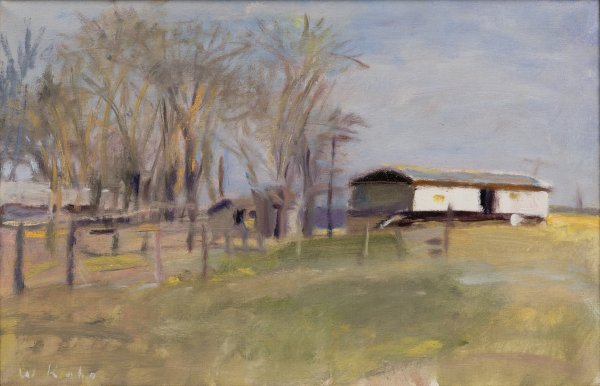
Mobile Home in Arkansas
Wolf Kahn
1927-2020
Whether working in oil or pastel, it was all about color for Hans Wolfgang Kahn. In a 1983 interview he said: "I am always trying to get to a danger point in color, where color either becomes too sweet or it becomes too harsh, it becomes too noisy or too quiet, and at that point I still want the picture to be strong, forceful, and the carrier of everything that a painting has to have: contrast, drama, austerity." The final product of this methodology is a well-orchestrated and luminous landscape dominated by trees and often featuring ordinary structures.
Kahn was born in Stuttgart, Germany, but the rise of antisemitism in the Weimar Republic disrupted his childhood and prompted his family's move to the United States, leaving three-year-old Kahn with his grandmother in Frankfurt. When he was twelve he went to London, and then the following year in 1940, he emigrated to New York. Despite the turmoil, he developed a precocious interest in art; he was drawing when he was four years old, and had private art lessons in the late 1930s often depicting military events and historical figures.
At New York's High School of Music and Art from 1942 to 1945, Kahn produced mostly caricatures. After a year serving in the United States Navy, Kahn took classes at the New School for Social Research with Stuart Davis. Not satisfied, he moved on and used the GI Bill to study with Hans Hofmann, the great German-American Abstract Expressionist who promulgated his "push-pull" theory of color. Kahn became his studio assistant in Provincetown, Massachusetts, during summer 1947 and subsequently in New York for a total of eighteen months. He then went on to the University of Chicago to study philosophy and in 1951 earned his Bachelor of Arts degree completing it in one year.
Kahn began showing his work in New York in the early 1950s and was active in the Hansa Gallery Cooperative alongside other Hofmann students. His main homestead would continue to be Vermont and New York, but he traveled frequently. Though he had already been visiting New Orleans since 1951, the summer of 1953 was the first time he stayed for longer with his brother, Peter, an art professor at Louisiana State University. He would return to the South frequently to paint and teach workshops in such places as Charleston, South Carolina; Lexington, Kentucky; Columbus, Georgia; Syria, Virginia; and Laurel Mississippi. He also spent time in Tepoztlán, Mexico, and in 1960 he went to the University of California, Berkley as a visiting professor for a year. Returning to New York, Kahn taught at Cooper Union throughout the 1960s, with occasional trips to Rome. Summers were spent in Deer Isle, Maine, until 1968, but then he purchased a farm in West Brattleboro, Vermont. In the 1970s, Kahn worked sporadically in Louisiana to jury art competitions and participate in exhibitions. Then, in 1998 the Morris Museum of Art in Augusta, Georgia, brought Kahn to South Carolina and commissioned a series of paintings of Southern scenery He would travel with Edward Rice to various locations to paint en plein air. Kahn remarked that the "reflective light" in the trees and the "weathered" structures of the rural South were appealingly different from anything he'd seen in the North.
During his long and successful career, Kahn received many honors, including a Fulbright Scholarship in 1962, a John Simon Guggenheim Fellowship in 1966, and an Award in Art from the American Academy of Arts and Letters in 1979. In addition, the Vermont Council on the Arts in 1998 gave him a Lifetime Achievement Award, as did the National Academy in 2006. From his alma mater, he was presented with the University of Chicago Outstanding Alumni Professional Achievement Award in 2012 and the United States State Department awarded him the International Medal of Art in 2017. He has an honorary doctorates from Wheaton College, in Norton, Massachusetts, given in 2000, and from Union College in Schenectady, New York, in 2004. The citation for the latter degree reads as follows: "Asked to describe your paintings, a colleague of yours once compared your work to a string quartet, where the four principal colors, or voices, resonate together in a tightly-structured composition.…You combine landscape and abstraction to create atmospheric and sensual paintings that are refreshments to our souls."
Wolf Kahn