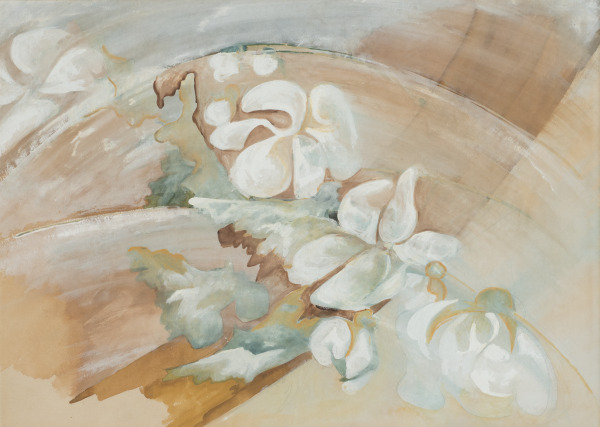
Still Life with Cyclamen
Zelda Fitzgerald
1900-1948
Frequently overshadowed by her husband F. Scott Fitzgerald, Zelda Sayre Fitzgerald was a writer, dancer, and painter who suffered from many demons. Her work in all three art forms was an attempt to establish her own identity. Born to a prominent family in Montgomery, Alabama, Zelda Sayre was the belle of the ball in her hometown. She met Lieutenant Fitzgerald while he was stationed at Camp Sheridan during World War I; they were married in 1920. He once declared, “I married the heroine of my stories.”
The Fitzgeralds maintained a highly visible and lively lifestyle throughout the 1920s—the Jazz Age and the age of the flapper. It was also itinerant: New York hotels, a summer rental in Westport, Connecticut, family visits to Montgomery, a rented estate near Wilmington, Delaware, transatlantic trips with stays in Paris, the French Riviera, Rome, and Capri. Their circle of associates included Gertrude Stein, Romaine Brooks, Ernest Hemingway, and Sara and Gerald Murphy. In the late 1920s Zelda rekindled her passion for ballet and studied in Paris with a Russian woman affiliated with the Diaghilev troupe, but the physical and mental demands of dance took a toll. She suffered her first breakdown in April 1930, and spent the next several months in and out of hospitals near Paris and in Switzerland. Her diagnosis, contested by some, was schizophrenia. In the fall of 1931 the couple returned permanently to the United States.
Despite being institutionalized intermittently, Zelda Fitzgerald wrote and painted frequently. In 1932 she published Save Me the Waltz, a heavily autobiographical novel, similar in approach to Scott’s Tender is the Night issued two years later. She also wrote short stories, articles, and a play. She had her first painting lesson at age twenty-five, exhibiting a good deal of natural talent. She made whimsical paper dolls for her young daughter and also illustrated Alice in Wonderland and Goldilocks and the Three Bears.
Stylistically, Fitzgerald’s paintings display the influence of modernism in their abstraction and surrealism in their fanciful quality. When she introduced figures—both human and animal—she tended to exaggerate their muscularity, inspired perhaps by her interest in dance. Ethereal flowers, probably begun while in Capri, are the focus of many of her watercolors, and sometimes are highlighted with gouache. Regrettably, many of her paintings have been lost or destroyed.
Zelda Fitzgerald spent months hospitalized in Baltimore, New York, and Asheville, North Carolina, although she did experience lucid periods. She was never committed, but chose to submit herself. She died at the Highland Hospital in Asheville in a fire caused by faulty wiring. Sadly, at the time of her death the insulin shock treatments she had been undergoing had improved her condition and she was anticipating returning to Montgomery. The Scott & Zelda Fitzgerald Museum in Montgomery maintains an extensive library of the couple’s writings as well as several of her paintings. Parts of the historic building are available for rent.
Zelda Fitzgerald