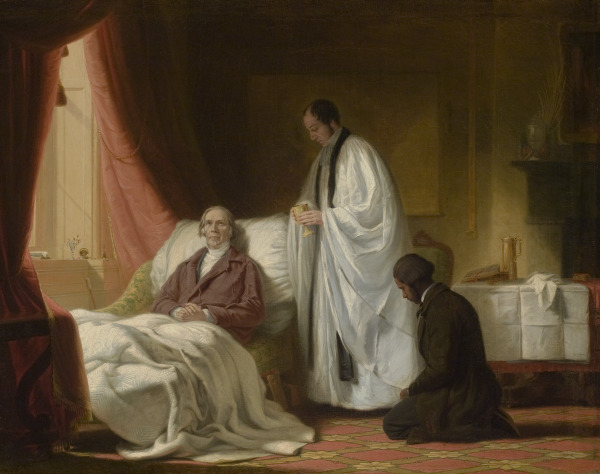
The Last Communion of Henry Clay
Robert Weir
1803-1889

Oil on canvas
23 5/8 in x 30 1/4 in
Circa 1852
New York native Robert Walter Weir taught himself to paint by making copies of Rembrandt prints before pursuing formal study in Italy from 1824 to 1827. It was there that Weir, a devout man who viewed art as a means of inspiring the faithful, created his first religious works, Christ and Nicodemus and The Angel Relieving Peter. Elected to the National Academy of Design in 1829, Weir later served as Professor of Drawing at the United States Military Academy, where his students included Ulysses S. Grant, Robert E. Lee, Seth Eastman, and James Abbott McNeill Whistler. Commissioned to paint a large mural for one of the four blank panels in the Capitol rotunda in Washington, D.C., Weir’s Embarkation of the Pilgrims was installed in the Capitol in 1843. From 1843 to 1876, Weir was active as a painter of landscape art in the Hudson River style, as a portraitist, and as a history and genre painter.
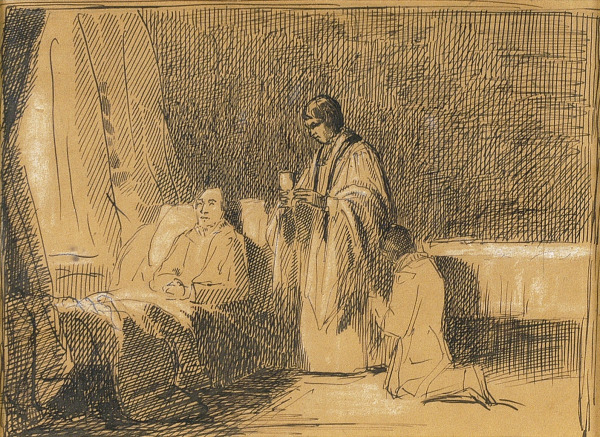
Weir’s personal reverence informs this deathbed image of the eminent Kentucky statesman Henry Clay. Drawing on contemporary newspaper reports of Clay’s last days in May 1852, the artist has depicted Dr. Clement Moore Butler, chaplain of the Senate, visiting the senator in order to administer the Eucharist. In a scene rich with Gothic images and reflective of Weir’s mastery of the light of the Hudson River school, Clay—suffering the malignant effects of both tuberculosis and extended political strife—is presented in pious submission to imminent death. The first person to lie in state in the United States Capitol, Clay’s remains were ultimately returned to Lexington, Kentucky. There, his grave is marked by a headstone that reads, “I know no North, no South, no East, no West.”
Taking Care: Images of Devotion and Caregiving within The Johnson Collection, Wofford College, Spartanburg, SC, September 3–December 12, 2025
Robert Weir
Robert Weir