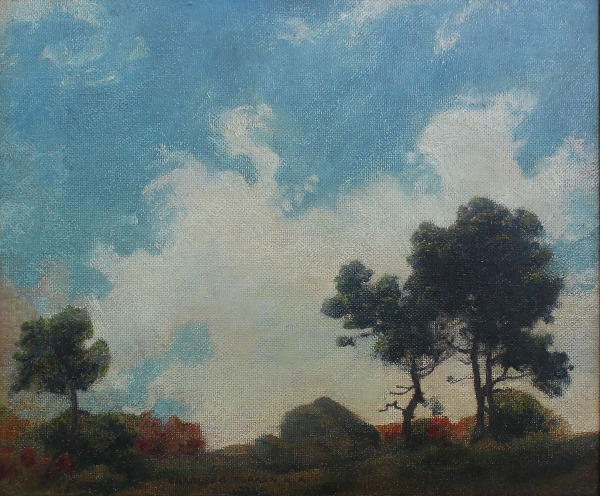
Hillside with Clouds
Charles Curran
1861-1942
Highly regarded for his captivating paintings of women indoors and out, Charles Courtney Curran is closely associated with the upstate New York art colony in Cragsmoor. He rose to recognition early in his career at a time when Impressionism was becoming popular, and he had a lengthy relationship with the National Academy of Design in New York.
Curran was born in Hartford, Kentucky, in the western part of the state, but because his father (an amateur painter) was sympathetic to the Union cause, the family moved to Ohio. His childhood was spent in Sandusky on the shores of Lake Erie and he graduated from the local high school. He displayed an early inclination for art, and in 1880/1881 was a student at the McMicken School of Design in Cincinnati, Ohio (now the Art Academy of Cincinnati), where Thomas Noble was the chief administrator.
In 1883 Curran headed to New York where he began studies at the National Academy of Design under Walter Satterlee, a figure and genre painter. At age twenty-three one of Curran's paintings was included in an exhibition at the Academy, inaugurating a long association with the august institution. Nevertheless, he transferred to the Art Students League where he worked with Walter Shirlaw, another figure painter. Like many of his contemporaries, Curran was attracted to Paris, to which he traveled in 1888 and then remained for two and half years. He studied at the Académie Julian with several portrait and figure painters including Jules Lefebvre and Jean-Joseph Benjamin Constant. Curran had a studio in Montparnasse and an apartment on the Île de la Cité. His work was selected for three consecutive Paris Salons: 1889, 1890, and 1891. That last year, he was chosen for an exhibition of American artists at the Durand Ruel Gallery which had been heavily promoting Impressionism.
Returning to the States in 1891, he established himself in New York and spent summers in Ohio until 1903 (some sources say 1904) when he was invited to Cragsmoor, an emerging art colony located in the Shawangunk Mountains ninety miles north of Manhattan. It had breathtaking views of the nearby Catskill Mountains which had attracted Edward Lamson Henry in 1879 and Edward Gay in 1905. Both Curran and Helen Turner built studios there in 1910. Many of the artists were active with the National Academy of Design, where Curran exhibited every winter from 1906 to 1932. He had been elected an associate in 1888 and a full academician in 1904. He also served on the Academy's council, including terms as recording secretary 1911 to 1920, then corresponding secretary until his death in 1942.
In addition, Curran taught not only at the Academy, but also at Pratt Institute in Brooklyn, and the Cooper Union and Art Students League in New York. Many of his students were women, the primary subject of his paintings, although he also did commissioned portraits. In his early work he tended to show his female sitters doing genteel activities, but after the first decade of the twentieth century they became more spirited, often outdoors in dazzling light against bright blue skies. From time to time he painted fresh depictions of the landscape en plein air.
Charles Curran