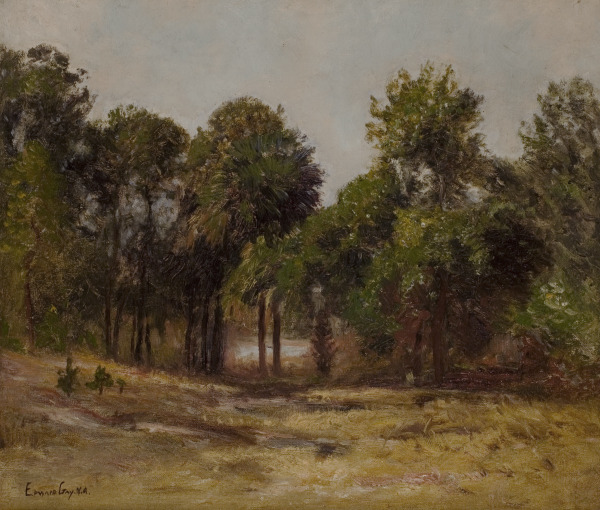
South Carolina Landscape
Edward Gay
1837-1928
A prolific painter of landscapes, Edward B. Gay was born in Mullingar, in central Ireland, and immigrated to the United States in 1848, a fateful year that saw the exodus of many Irish to North America. According to family sources, however, the Gays came to America largely because Edward's father was a political agitator. Arriving in Albany, New York, the family's situation required young Edward to work; one job was in a wine cellar. When he displayed a talent for drawing, he began studying with select local painters, including George Boughton and the brothers William and James Hart.
In 1862, he went to Karlsruhe, Germany, to continue his education under the conventional historical painters Johann Schirmer and Karl Frederich Lessing. Gay, whose work defies strict categorization, believed the time there ill-spent and returned to the United States in 1864. As an aspiring artist, Gay ventured on sketching trips, like the Hudson River School painters a generation earlier, and from these forays evolved his finished paintings. He did not romanticize or idealize, but instead depicted what he saw.
Gay ultimately settled with his family in Mount Vernon, New York, where he painted the area's bucolic farmland, pastures, and orchards. The location provided easy access to Manhattan's art circles; he was popular as a raconteur and master of ceremonies. He regularly exhibited at the National Academy of Design but only attained full rank of academician late in his career, in 1907 at the age of seventy. Twenty years before the American Art Association had awarded Gay a prize of $2,500 for a large landscape painting, Broad Acres, which was given to the Metropolitan Museum of Art.
Traveling to London in 1881, Gay was enthralled with the paintings of John Constable on view at the National Gallery. The English master's broad skies, low horizons, and textured surfaces affirmed Gay's artistic inclinations. At about this same time, a reviewer commented on an exhibition of his paintings: "The freshness, the freedom, the poetic truth and abundant sunshine in not a few of these canvases show that Mr. Gay has gone for his inspiration out of doors and studied nature in some of her enchanting moods. The artistic instinct which has led him to depict some quiet nook or broader stretch of country with his facile brush was everywhere apparent."
In 1898 Gay made his first visit to South Carolina to visit his daughter Vivien who had married into the Coker family of Hartsville, in the state's Pee Dee region. Accustomed to the rolling terrain of upstate New York, he found the area around Hartsville "weary, stale, flat, and unprofitable," and even labeled one sketch of Black Creek, The River Styx, S.C. More to his liking were coastal scenes, such as those found at the newly developed Isle of Palms.
In 1903 he built a summer home at Cragsmoor in upstate New York, an artist colony frequented by Charles Curran and Helen Turner. The setting provided additional subject matter for his brush, as did regular trips to Europe. In 1905, he won the George Inness Gold Medal, named for the most prestigious American landscape painter of the day. While some of Gay's paintings sold at a premium price, many of his works barely covered expenses, and he was often strapped for money. The average price for one of his paintings circa 1900 was about $150, $5,500 in 2025 dollars. The artist's work is represented in the collections of the Metropolitan Museum of Art, Smithsonian American Art Museum, National Academy of Design, New-York Historical Society, and the Gibbes Museum of Art.
Edward Gay
Edward Gay