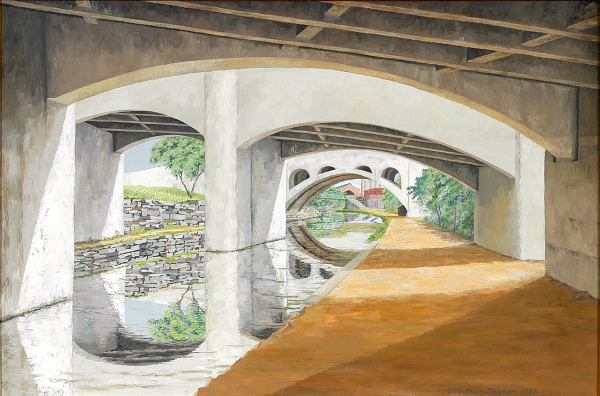
Along the C and O Canal, Washington, DC
Prentiss Taylor
1907-1991
Both painter and printmaker, Richard Prentiss Hottel Taylor was highly regarded for his lithographs. Over his long career he created 142 editions, many of which accompanied texts.
Taylor was born in Washington, DC, and lived in that area most of his life except for a few sojourns and extensive travels. Initially he went to McKinley Technical High School (now McKinley Technology High School) but graduated in 1925 from Sidwell Friends School, a private Quaker institution. He began art studies at the Corcoran Gallery of Art School (now the Corcoran School of Arts and Design at Georgetown University) around the same time that Gladys Nelson Smith and Lucy Diecks were students there. In 1924 Taylor studied in Provincetown, Massachusetts, with Charles Hawthorne at the Hawthorne School of Art (later the Cape Cod School of Art) where plein-air painting was emphasized. William H. Johnson was a student and studio assistant at that time.
In the late 1920s, Taylor enrolled at the Art Students League in New York. In 1931 he discovered lithography and worked with George C. Miller, a noted printer who collaborated with such artists as Thomas Hart Benton, George Bellows, and Lyonel Feininger. Typically an artist composed the design and Miller printed it. Years later, Taylor commented: "With the first magic feeling of the crayon working in the fine grain of stone, I knew I was at home in lithography." Taylor was inventive with the process, making what he called "lithoprints." He would draw on the lithographic stones with brushes and lithographic ink rather than crayon, a method that was more spontaneous, allowing halftones and tonal gradations similar to a wash drawing.
While in New York, in addition to working with Miller, Taylor designed costumes for the American-Oriental Revue, and also scenery for the Arts Club of Washington. He was in residence four times between 1928 and 1932 at the MacDowell art colony in Peterborough, New Hampshire, an interdisciplinary program in an idyllic setting. There he met Aaron Copland, with whom he purportedly had a romantic liaison. Also at MacDowell was Josephine Pinckney, author of Three O'Clock Dinner set in her hometown of Charleston, South Carolina. Taylor's time in New York coincided with the Harlem Renaissance and he quickly became friends of two exemplars of the movement, writer Langston Hughes and photographer Carl Van Vechten. Toward the end of 1931, Taylor, together with Hughes, established the Golden Stair Press as a vehicle for the publication of Hughes's writings, accompanied by Taylor's illustrations. Their most notable collaborations were The Negro Mother and Other Dramatic Recitations and the powerful Scottsboro Limited. Later Taylor launched the Washington Wheat Press which featured poetry and prose selections along with his prints.
At Pinckney's instigation, Taylor visited Charleston. He recalled: "I arrived on the Clyde-Mallory Line Steamer about the end of May 1933. … I was lent the Pink House on Chalmers Street and I was able to stay until Labor Day. I spent most of my time sketching, up one side of the street and down the other." Unlike Charleston Renaissance native artists Alice Ravenel Huger Smith and Elizabeth O'Neill Verner, Taylor, who was an outsider, felt comfortable prowling the edgier sections of the city. With their dark tonalities, the resultant lithographs are unlike other imagery produced then and there. In 1934 Taylor returned to Charleston under the auspices of the Public Works of Art Project, a short-lived New Deal program. He returned there regularly throughout his career.
The following year, 1935, Taylor returned to Washington and was an instructor of lithography at Studio House, which had been established by Alice Pike Barney and was later affiliated with the Phillips Memorial Gallery. He shifted gears and between 1943 and 1954 served as an art therapist at St. Elizabeth's Hospital. He later joined the staff in a similar capacity at Chestnut Lodge, a psychiatric institution in Rockville, Maryland. In 1950 he contributed an article in the American Journal of Psychiatry entitled, "Art as Psychotherapy." In 1942 he became the President of the Society of Washington Printmakers, a position he held for thirty-four years. Six years later he was elected an associate of the National Academy of Design in New York.
Taylor was an inveterate traveler. In 1936 he was in the Virgin Islands, followed four years later with a trip to Mexico, returning there again in 1962. Stateside he spent time in New England, and in 1958 he traveled to New Mexico and Colorado. He went abroad in 1964 and 1969 to Spain, Italy, and France, and to the Low Countries, the United Kingdom, and Russia. In 1975 he returned to Italy, and visited Austria, Munich, Germany, and Lugano, Switzerland. Ten years later his travels took him to France and Denmark, followed in 1988 by trips to the west coast of France, Spain, and Portugal. In each location he found inspiration for his art, evolving toward an expressive kind of realism in which he examined architecture, religion, social justice, and music.
Prentiss Taylor