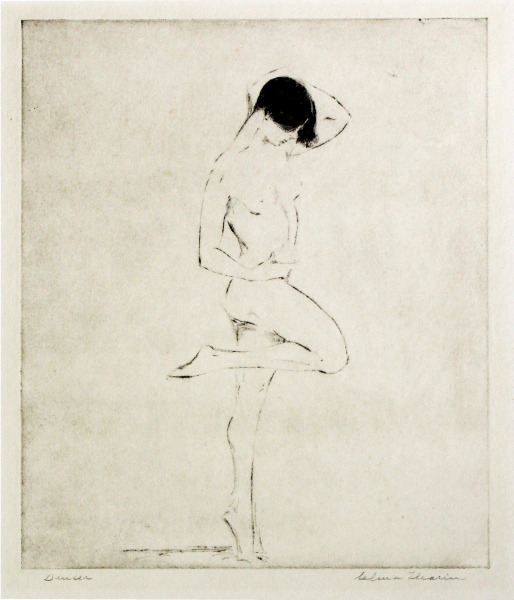
Dancer
Selma Tharin
1904-2001
Selma Marie Tharin had multiple artistic interests: visual art, dance, and theater. She is also known by her married names: first Selma Tharin Furtwangler, then Selma Dotterer.
Tharin was born in Charleston, South Carolina, and went to Memminger High School. She attended the College of Charleston which had been an all-male institution until 1918. Under the auspices of the Carolina Art Association, which managed the Gibbes Art Gallery (now the Gibbes Museum of Art), she took art classes with Alfred Hutty who started teaching there in 1920. In a 1997 interview she explained: "My mother was interested in my becoming a violinist, but that was not my cup of tea. [I pleaded] ‘Please let me go to the Gibbes Art Gallery's new school'—that's how I got into art."
In 1923 Hutty was one of the nine founding members of the Charleston Etchers' Club, along with Alice Ravenel Huger Smith, Elizabeth O'Neill Verner, and Ellen Day Hale. Subsequently Tharin joined the group and made a few etchings, one of which portrays a dancer. The figure was probably based on herself since there were no life drawing classes with nude models available locally at the time.
In 1925 Tharin was working as a stenographer; this was before she and a friend departed for New York where they joined the Ziegfeld Follies. In summer 1929 she was a member of the chorus in Show Girl with Ruby Keeler on Broadway. Tharin performed with the Follies in both Chicago and Atlantic City, New Jersey. Around 1930 she returned to Charleston where she served as secretary of the board of the Footlight Players, a community theater group established in 1931. The following year she played in Death Takes a Holiday and in 1937 she was the lead in Mary Queen of Scots. In 1946 Hutty completed a nine by eighteen foot mural for the theater which depicted twenty-four historical figures. Tharin was also on the executive board of the Poetry Society, another entity together with the artists and the preservation movement that helped fuel the Charleston Renaissance. During the 1930s and into the 1940s Tharin was the society editor of the local newspaper, Evening Post.
Selma Tharin